Published June 24, 2026 · Practical reference for used clothing importers
How Much Is a KG of Clothes? 2026 Weight Chart & Pieces per KG — A Complete Reference for Used Clothing Importers
When you buy used clothing by the kilogram — as most importers do — you are not buying weight. You are buying pieces. The number of items you get per kilogram determines your inventory, your pricing, and your profit.
Yet most importers cannot answer a simple question: how many pieces are in a kilogram of used clothing?
From our perspective as a Chinese exporter who has shipped over 7,000 containers, we have seen importers consistently miscalculate their per-item costs because they did not understand the weight-to-pieces relationship. A bale of winter coats at $2.50/kg sounds the same as a bale of t-shirts at $2.50/kg — but your cost per item is completely different.
This reference guide provides a 2026 weight chart with pieces per kilogram across all major used clothing categories, explains how to calculate your true cost per item, and shows why understanding weight is the key to profitable importing.
⏱ 10 min read · For importers calculating per-item costs
In this guide:
- Full weight chart: pieces per kg by category (t-shirts, jeans, jackets, dresses, etc.)
- Why lightweight items can be more profitable than heavy ones
- How to calculate your true cost per item — not just cost per kg
- Weight differences between origins (China vs Europe vs USA)
- Common misconceptions about “how much is a kg of clothes”
📊 2026 Weight Chart: Pieces per KG by Category
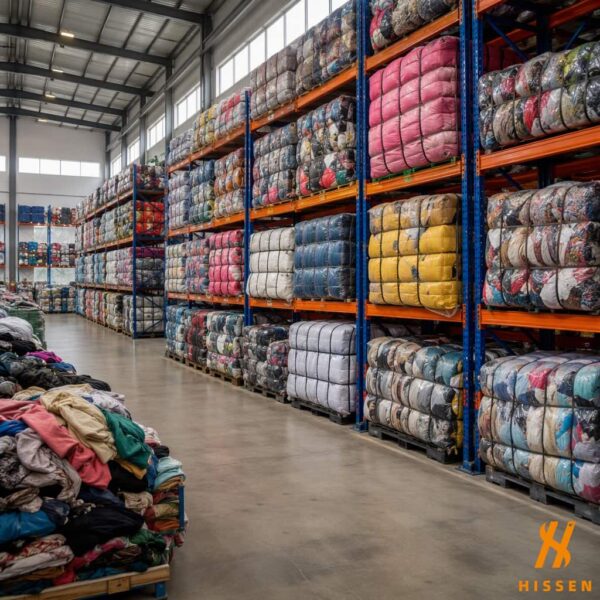
Here is the reference chart used by professional importers. These numbers are based on actual bale contents from Chinese, Korean, and European sorting facilities:
| Category | Avg Weight per Item | Pieces per KG | Pieces per 55 KG Bale |
|---|---|---|---|
| T-shirts (short sleeve) | 0.15-0.20 kg | 5-7 | 275-385 |
| T-shirts (long sleeve) | 0.20-0.25 kg | 4-5 | 220-275 |
| Polo shirts | 0.20-0.30 kg | 3-5 | 165-275 |
| Casual shirts (men) | 0.25-0.35 kg | 3-4 | 165-220 |
| Blouses (ladies) | 0.15-0.25 kg | 4-7 | 220-385 |
| Dresses (light summer) | 0.20-0.35 kg | 3-5 | 165-275 |
| Dresses (heavy/winter) | 0.40-0.60 kg | 1.5-2.5 | 80-140 |
| Jeans / denim pants | 0.50-0.70 kg | 1.4-2 | 77-110 |
| Cotton pants / trousers | 0.35-0.50 kg | 2-3 | 110-165 |
| Jackets (light) | 0.40-0.60 kg | 1.5-2.5 | 80-140 |
| Jackets (heavy/winter) | 0.60-1.00 kg | 1-1.7 | 55-95 |
| Sweaters / knitwear | 0.30-0.50 kg | 2-3.5 | 110-190 |
| Hoodies / sweatshirts | 0.40-0.60 kg | 1.5-2.5 | 80-140 |
| Shorts | 0.20-0.35 kg | 3-5 | 165-275 |
| Skirts | 0.20-0.35 kg | 3-5 | 165-275 |
| Shoes (mixed pairs) | 0.50-0.80 kg | 1.2-2 | 48-50 per 25 kg |
| Baby / children clothing | 0.08-0.15 kg | 7-12 | 385-660 |
Note: These are averages based on typical A Grade sorted bales. Actual weights vary by brand, fabric, size, and origin. European and US items tend to be slightly heavier due to larger average sizes.
[[IMAGE 1: Visual weight chart showing the pieces-per-kg range for each category as horizontal bars — long bars for lightweight items like t-shirts and baby clothes, short bars for heavy items like jeans and jackets.]]🧮 Why Pieces per KG Matters More Than Price per KG
Here is a calculation every importer should run before placing an order:
| Scenario | T-Shirt Bale | Jeans Bale |
|---|---|---|
| FOB price | $2.50/kg | $2.50/kg |
| Bale weight | 55 kg | 55 kg |
| Total FOB cost | $137.50 | $137.50 |
| Pieces per bale | ~300 t-shirts | ~90 jeans |
| Cost per item (FOB) | $0.46 | $1.53 |
| Typical wholesale price | $2-4 each | $4-8 each |
| Revenue per bale (est.) | $600-1,200 | $360-720 |
Both bales cost the same per kg. But the t-shirt bale generates more total revenue because you have more items to sell. This is why understanding pieces per kg directly affects your bottom line.
🌍 How Origin Affects Weight per Piece
Where your used clothing comes from affects average item weight. Here is what we see as a Chinese exporter serving multiple origins:
| Origin | Avg Item Weight | Why It Differs | Impact on You |
|---|---|---|---|
| 🇨🇳 China | Lighter (0.2-0.5 kg avg) | Smaller average body sizes, lighter fabrics common in Asian fashion | More pieces per kg — better for volume sellers |
| 🇰🇷 South Korea | Lightest (0.15-0.4 kg avg) | Fashion-focused, lighter fabrics, trend-driven fast fashion | Most pieces per kg — best for item-count focused buyers |
| 🇪🇺 Europe | Medium (0.25-0.55 kg avg) | Moderate sizes, mix of fast fashion and quality basics | Balanced — good quality, moderate item count |
| 🇺🇸 USA | Heaviest (0.3-0.7 kg avg) | Larger average sizes, heavier fabrics, branded casual wear | Fewer pieces per kg — but higher branded content |
The practical implication: if you buy from Korea or China, you get more items per container than if you buy the same weight from the US or Europe. For volume-focused importers, Asian origins offer better per-kg value.
Real-World Container Comparison
A 40ft container holds approximately 20,000 kg of used clothing. Your origin choice dramatically affects how many pieces you can sell:
- Korean bales (avg 0.25 kg/item): ~80,000 pieces per container — highest item count
- Chinese bales (avg 0.30 kg/item): ~66,000 pieces per container — excellent volume
- European bales (avg 0.40 kg/item): ~50,000 pieces per container — balanced profile
- US bales (avg 0.50 kg/item): ~40,000 pieces per container — higher branded %, lower count
Neither is better — they serve different market strategies. The key is knowing your numbers before you order.
For branded-item focused importers, US and European heavier items may justify the lower piece count.
📦 How to Calculate Pieces per Bale
Use this simple formula:
Pieces per bale = Bale weight (kg) × Pieces per kg (from chart above)
Examples using the chart:
- 55 kg bale of mixed ladies tops (avg 5 pieces/kg) = 55 × 5 = ~275 pieces
- 55 kg bale of mixed jeans (avg 1.7 pieces/kg) = 55 × 1.7 = ~94 pieces
- 45 kg bale of mixed children wear (avg 9 pieces/kg) = 45 × 9 = ~405 pieces
- 25 kg bale of mixed shoes (avg 2 pairs/kg) = 25 × 2 = ~50 pairs
💰 Why Lightweight Items Can Be More Profitable
This is a counterintuitive insight that many new importers miss: the lightest items often generate the highest total revenue per kg.
A kg of t-shirts (5-7 pieces) costs the same FOB as a kg of jeans (1.4-2 pieces). But the t-shirts, individually, will sell. Even at lower per-item prices, the total revenue from 5-7 t-shirts typically exceeds the revenue from 1.5 pairs of jeans.
Here is the rule of thumb we use: if two bales cost the same per kg, the one with more items per kg usually generates more total revenue. There are exceptions (branded jeans can sell for 5-10x a basic t-shirt), but for standard mixed bales, lightweight categories drive volume.
📋 Practical Application: How to Use This Data When Ordering
Knowing pieces-per-kg data is useful, but applying it correctly is what separates smart importers from the rest. Here is a practical workflow:
- Know your market’s price point. What do your customers pay per item? If you sell t-shirts at each, you need your cost per item to be under . Using the chart, that means you need bales at approximately -7/kg or less landed — which Chinese A Grade bales easily achieve.
- Calculate backwards. Start from your target retail price, subtract your margin, and work back to the maximum landed cost per kg you can afford. Then compare that number with supplier quotes.
- Adjust for your market’s size profile. If you serve West Africa (larger sizes), reduce the pieces-per-kg estimates by 10-15%. If you serve East Asia (smaller sizes), increase by 5-10%.
- Track your actuals. When your first container arrives, count the items in a sample bale. Compare with the chart. Adjust your calculations for future orders.
⚠️ Common Weight Misconceptions
After 12 years in this business, here are the most common mistakes we see:
“55 kg of clothes always means 55 kg of sellable items”
No. A 55 kg bale contains the bale itself (packaging, strapping), and potentially some moisture. Expect 1-2% variance. More importantly, the grade determines how many of the items are sellable. Always factor in your sell-through rate, not just the gross weight.
“Heavier items always mean higher profit”
Not necessarily. A winter coat may sell for $15-25, but a 55 kg bale only holds 55-95 coats. A t-shirt bale with 275-385 shirts at $2-4 each often generates more total dollars — even though each shirt sells for less.
“All origins have the same weight-per-item profile”
As shown in the origin comparison table above, this is false. Korean bales have the lightest items (most pieces per kg). US bales have the heaviest (fewest pieces per kg). Your choice of origin directly affects your per-item cost.
❓ Frequently Asked Questions
How do I calculate my true cost per item?
How many t-shirts are in a kg of used clothing?
How much does a kg of used jeans cost?
How many pieces of clothing are in 1 kg?
Does origin affect how many pieces per kg I get?
How many kilograms of used clothing fit in a container?
📐 Master Your Numbers — Get Category-Specific Data for Your Market
Understanding weight-to-pieces is the foundation of profitable used clothing importing. But the numbers vary by category, origin, and your specific market.
We help importers calculate their expected item counts, landed costs, and profit projections before they place their first order — so there are no surprises when the container arrives.
Get your personalized calculation:
- 📊 Category-specific pieces-per-kg data for your target market
- 📦 Expected counts per bale or container based on your preferred origin
- 💰 Landed cost projection including freight, duties, and port charges
- 📋 Sample bale content photos showing actual item weights