The bulk office supplies market has a quality problem that is easy to hide in a carton. A buyer orders bulk notebooks and receives a mixed load of recycled exercise books, dried-out pens and duplicated designs. The price looks competitive until the container is opened and half the assortment has to be sorted, discounted or discarded.
HS BOX was built for buyers who need the opposite: 100% new stationery stock, sourced from legitimate Chinese factories, packed to a defined specification and sold by the kilogram. Ten product categories, roughly 80 pieces per 17 kg carton, around 50 SKUs, and a fixed high-value core in every box.
This is not a pile of clearance residue. It is a container programme for importers, port and warehouse wholesalers, school-supply distributors and discount retailers who need variety, dependable quality and a price they can plan a margin around.
In this guide you will learn:
- How HS BOX sources new stationery stock from Guangzhou and Yiwu
- The ten stationery categories packed into every container
- The fixed carton configuration and 20ft / 40ft specifications
- Why new factory stock and branded stationery reduce buyer risk
- How to request the current packing list and container pricing
1. Brand Origin and HS BOX Background
HS BOX draws on more than 14 years of sourcing and export experience across Guangzhou and Yiwu, China’s two densest small-goods supply bases. Guangzhou provides the export infrastructure and access to household, appliance, electronics and general merchandise supply. Yiwu — the world’s largest small-commodity market — is where variety is bought: stationery, school supplies, creative goods and the long tail of small items that make a mixed container commercially interesting.
That combination matters for stationery wholesale. A single factory can supply one product family at volume, but it cannot supply a container that sells across a school-supply aisle. HS BOX buys across factories and wholesale clusters, screens the output, and presents it as one standardised programme.
The problems HS BOX was built to fix
Importers sourcing bulk stationery from overseas repeatedly run into the same failures:
- Recycled and second-hand stationery sold as new. Used or repackaged goods are blended into shipments and described as factory surplus.
- Poor writing performance. Pens that dry out, leak or skip — a defect the buyer only discovers after the container lands.
- Single-category or repetitive shipments. A container of one notebook style is easy to price and hard to sell across a retail floor.
- Low-value filler. Shipments padded to weight with items that cost freight and sell for nothing.
HS BOX’s stationery line answers all four. Stock is new, unused factory inventory: over-season production, order surplus and factory end-of-line goods. The assortment spans ten categories. Every carton carries a fixed high-value core, and the reference defect rate is around 5%, concentrated in pens that do not write and damaged original packaging — not in the assortment itself.
Two lines define the brand: “Open a Box. Open a Market.” describes what buyers do with our cartons; “Mixed Products. Consistent Quality.” describes the standard we hold before those cartons leave the warehouse.
Why a kilogram-based stationery programme works
Most stationery is bought by the piece or by the pack. HS BOX prices the mixed programme by kilogram at a reference USD 2.5/kg, which changes the economics in three ways: the buyer can compare suppliers on a single transparent unit; the landed cost per carton is predictable; and the mix can be adjusted to the buyer’s market without renegotiating every SKU.
For a bulk stationery suppliers comparison — or any wholesale stationery supplies shortlist — that is the practical difference between a catalogue quote and a container programme.
2. Stationery Product Categories and Container Specifications
The ten stationery categories
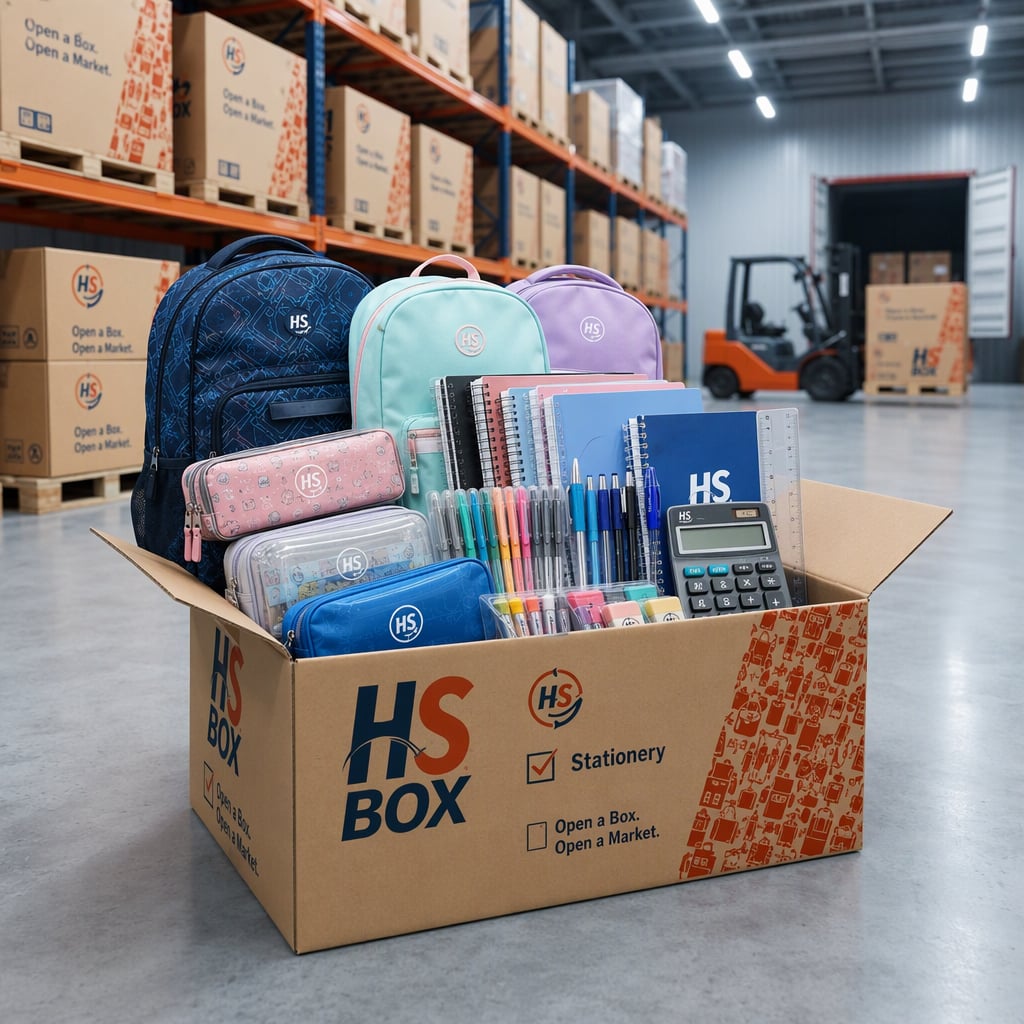
Every container is built from ten product families, so the buyer gets an assortment rather than a single line:
- Backpacks, pencil cases and pouches — the fixed high-value core of every carton.
- Writing instruments — gel pens, ballpoint pens, pencils, coloured pens, markers and chalk.
- Art and drawing supplies — watercolour pens, coloured drawing pens and drawing books.
- Notebooks and paper goods — notebooks, journals, writing books and exercise books.
- Filing and organisation — folders, document bags and book covers.
- Maths and measuring tools — rulers and compasses.
- Correction supplies — erasers and correction tape.
- Office stationery — calculators and desk essentials.
- Cultural and creative supplies — cartoon stickers, decorative stickers, character stationery and educational items.
- Other stationery and container sports items — including table tennis paddles, badminton rackets, footballs and basketballs, randomly assorted at container level.
That spread is what makes the line suitable for office supplies wholesale buyers serving schools, discount chains, market traders and online sellers at the same time.
Carton configuration
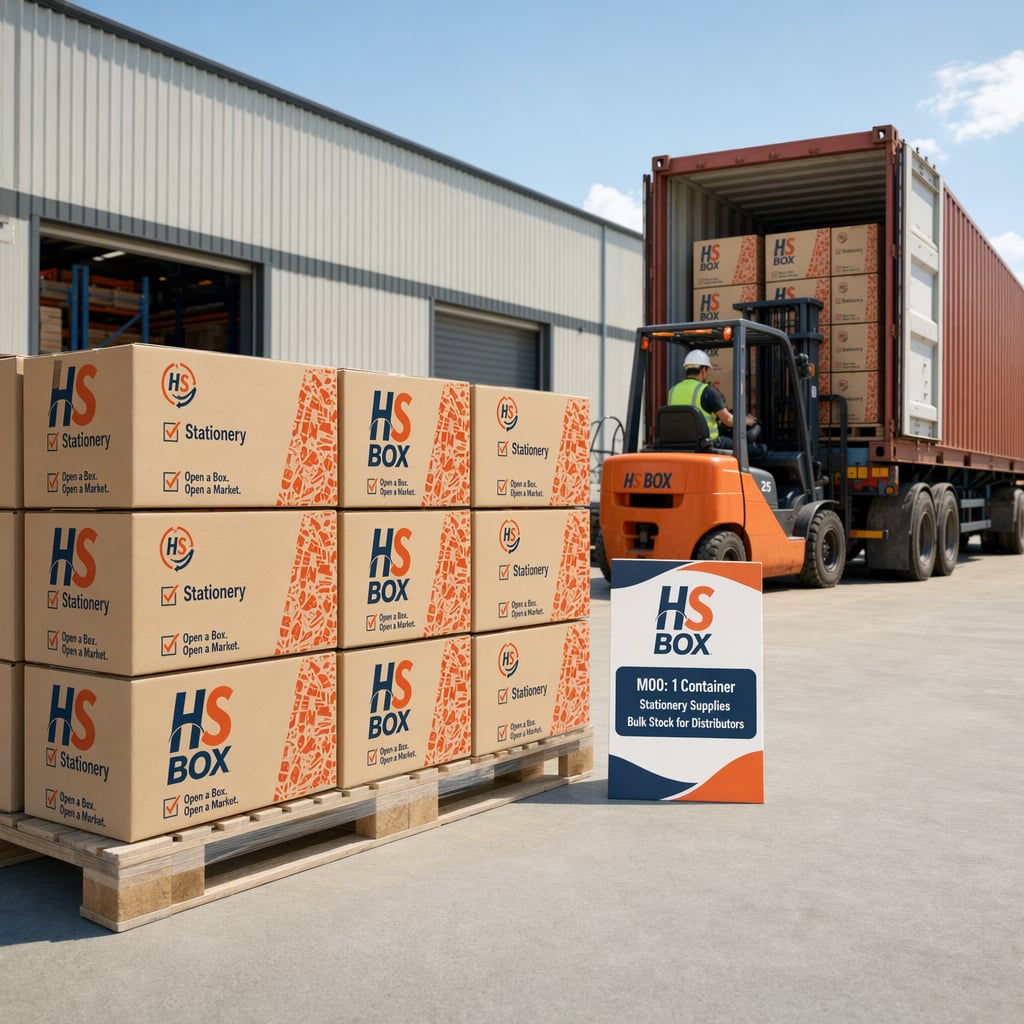
Each carton is built to a fixed structure:
- Weight: approximately 17 kg per carton.
- Quantity: around 80 pieces per carton, with a ±5% tolerance.
- Variety: roughly 50 different stationery products per carton.
- Fixed core: 1 backpack + 1 pencil case + 1 pencil pouch, plus spare pen refills.
- Random mix: about 60% writing instruments, 30% notebooks and exercise books, 10% other small stationery, measured by piece count.
The 60/30/10 split is a reference structure, not a guarantee that every carton contains every item. Product types, brands, colours and styles rotate with the batch — which is exactly what keeps a mixed container commercially interesting and reduces duplicate stock on the shelf.
Container specifications
| Specification | 20ft container | 40ft container |
|---|---|---|
| Carton size | 46 × 25 × 58 cm | 46 × 25 × 58 cm |
| Carton weight | 17 kg | 17 kg |
| Cartons per container | 440–450 | 908 |
| Gross weight | ~7.5–7.7 tonnes | ~15.4 tonnes |
| Indicative container value | USD 20,000 | USD 40,000 |
Reference pricing is USD 2.5/kg. Container values are indicative for the current programme and move with the batch, category mix and freight. Current supply is approximately 3 containers per month.
3. Core Competitive Advantages
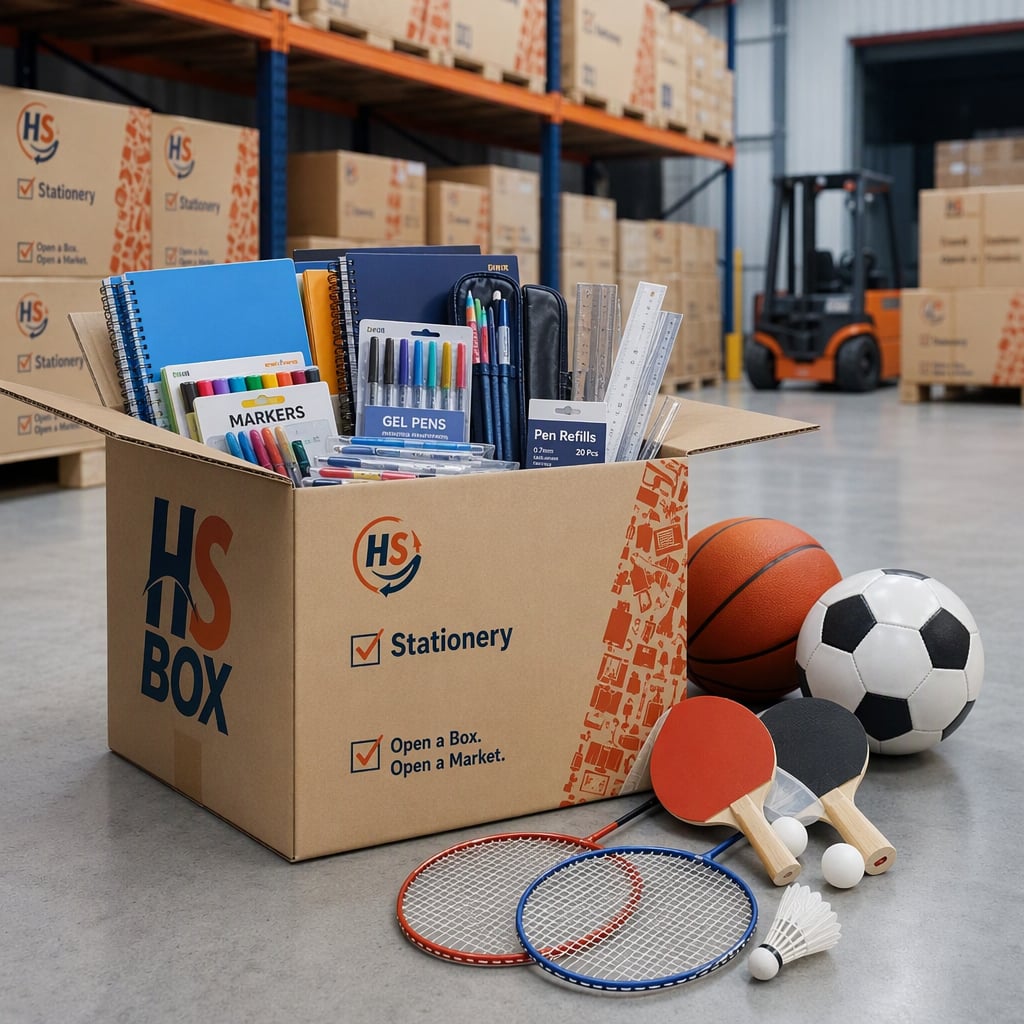
Rich SKU coverage: ten categories, ~50 products, ~80 pieces
The value of a mixed stationery carton is breadth. Ten categories, around 50 products and roughly 80 pieces per carton give the buyer more sellable lines per cubic metre and reduce the risk that one slow-moving design sinks the load. The mix is deliberately optimised to reduce concentrated repetition of the same item, so bulk notebooks, bulk journals, composition books bulk and composition notebooks in bulk arrive as an assortment rather than a single style.
100% new factory stock — not second-hand
All stationery is new, unused factory inventory: over-season production, order surplus and factory end-of-line goods from legitimate Chinese stationery manufacturers. It is not recycled or second-hand merchandise. The reference defect rate for the batch is around 5%, mainly pens that do not write correctly and original packaging that is damaged. Buyers should price that figure into the landed cost, as they would with any stocklot programme.
Branded stationery mixed in
The line includes M&G (Chenguang) and other Chinese brand stationery alongside factory surplus. Branded items provide a quality reference point within the assortment and make the mixed carton easier to present to retail buyers who want a recognisable name alongside unbranded value lines. For a wholesale stationery manufacturer comparison, that mix is a useful signal of source quality.
Fixed high-value items, spare refills and container sports goods
Every carton carries one backpack, one pencil case and one pencil pouch, plus spare pen refills for downstream replacement. At container level, HS BOX adds randomly assorted sports goods — table tennis paddles, badminton rackets, footballs and basketballs. These are container-level extras rather than a per-carton guarantee, and the exact mix depends on the loading batch, but they raise the value structure of the load without changing the carton specification.
A mix built for multiple retail channels
The same container can supply a school-supply wholesaler, a discount chain and an online seller. Writing instruments and ink pens in bulk serve high-frequency replenishment; bulk spiral notebooks, notebooks wholesale and wholesale journals serve back-to-school and office demand; creative and correction items fill the impulse end of the shelf. One programme, several selling seasons.
4. Why Choose HS BOX?
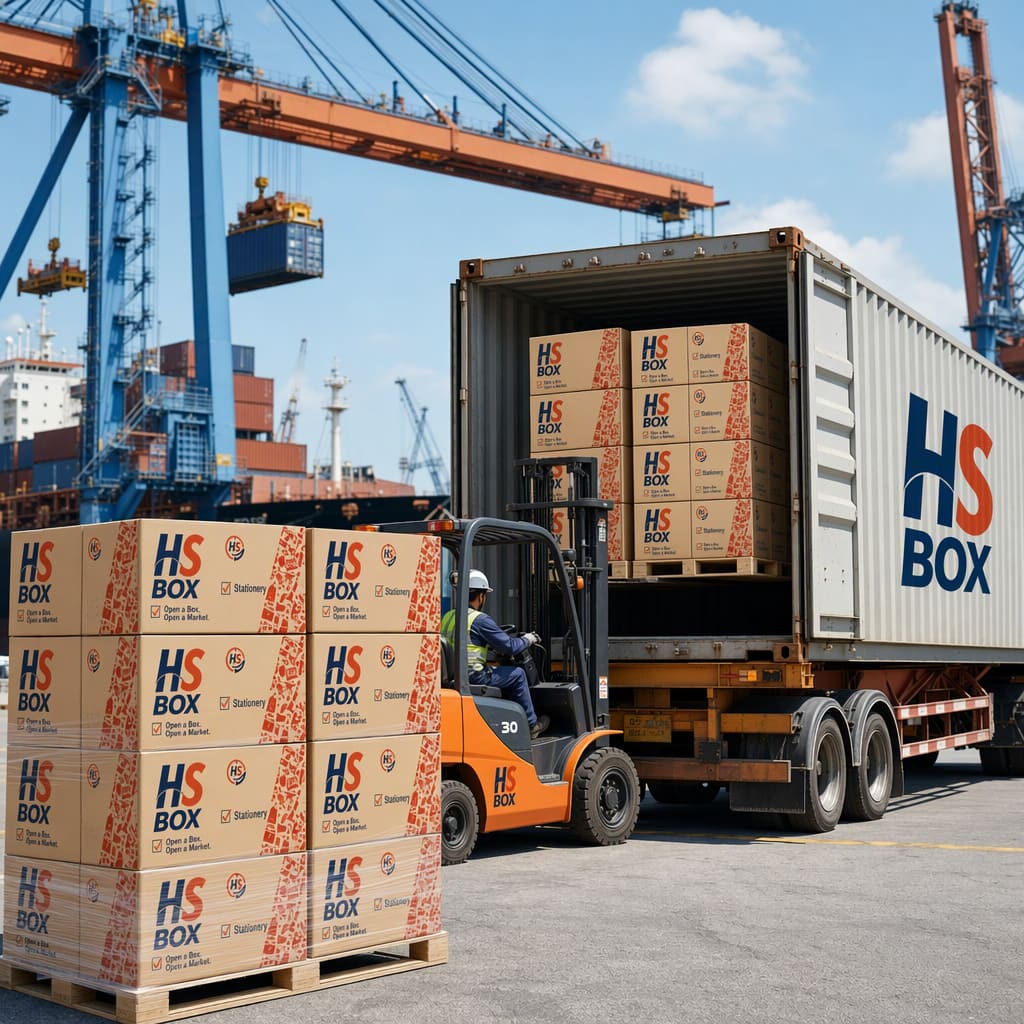
Four commercial outcomes matter to a container buyer. HS BOX is built around all four.
Clear pricing and a workable margin. A reference USD 2.5/kg and defined container yields let a buyer model landed cost before committing. For bulk office products buyers who compare quotes across suppliers, that transparency is often worth more than a marginally lower headline price.
Rich assortment and high-value structure. Ten categories, a fixed backpack/pencil case/pouch core, spare refills and container-level sports goods give the load a value profile that a single-SKU container cannot match.
Reliable new factory stock with a controllable defect rate. New, unused inventory from legitimate Chinese factories, with a reference defect rate around 5%, gives office supplies distributors a line they can price honestly rather than discover at the port.
Inspection and long-term supply. Buyers are welcome to visit the Guangzhou facility to inspect stock and review the packing process. With roughly 3 containers per month available, the programme supports repeat ordering rather than a one-off purchase. Our quality standards describe the same discipline across the business.
Who the programme fits
- Port and warehouse container wholesalers who need a full load of sellable stationery with a known carton count.
- School-supply distributors preparing for back-to-school and exam seasons.
- Discount retailers and dollar-store chains that need breadth across categories at a low unit cost.
- Office supplies distributors and online sellers who want a repeatable mixed assortment.
If your business depends on variety at container scale, this specification is designed for you. If you need a single SKU in a single design, a factory-direct order is the better route — and we will say so.
A note on paper. Buyers searching for bulk copy paper by the ream are usually looking for a mill-direct paper purchase rather than a mixed stocklot programme. HS BOX’s stationery line covers notebooks, exercise books, journals and writing instruments; for a full-pallet copy-paper requirement, a dedicated paper mill is the better source. We would rather qualify the request than ship the wrong product.
Start with the current packing list
Send us your category focus, target market and container size, and we will return the current packing list, carton specifications, indicative container pricing and the latest batch details for the stationery line. You are also welcome to visit our Guangzhou facility to inspect stock, review the screening process and see a live loading.
Open a Box. Open a Market.
💡 Key Takeaways
- 100% new factory stationery, not recycled or second-hand; reference defect rate around 5%.
- Ten categories, roughly 50 products and ~80 pieces per 17 kg carton (±5%).
- Every carton includes 1 backpack + 1 pencil case + 1 pencil pouch + spare pen refills.
- Reference pricing USD 2.5/kg; 20ft ≈ 440–450 cartons (USD 20,000), 40ft ≈ 908 cartons (USD 40,000).
- Random container-level sports goods and M&G branded stationery mixed in.
- Current supply around 3 containers per month.
Frequently Asked Questions
Is HS BOX stationery new or second-hand?
All stationery is new, unused factory inventory — over-season production, order surplus and factory end-of-line goods. It is not recycled and not second-hand. The reference defect rate is around 5%, mainly pens that do not write and damaged original packaging.
How many pieces are in each carton?
Each carton weighs approximately 17 kg and contains around 80 pieces across roughly 50 stationery products, with a ±5% quantity tolerance.
What is fixed in every carton?
Every carton includes one backpack, one pencil case and one pencil pouch, plus spare pen refills. The remaining stationery is randomly mixed at a reference ratio of about 60% writing instruments, 30% notebooks and 10% other small stationery.
How is the stationery priced?
The mixed programme is quoted by kilogram at a reference USD 2.5/kg. A 20ft container is indicatively valued at USD 20,000 and a 40ft container at USD 40,000, subject to batch, mix and freight.
Can I choose specific designs or brands?
No. The value of the line is breadth at container scale, so products are mixed by brand, design, colour and style. Individual selection is not supported.
How quickly can a container ship?
Current supply is approximately 3 containers per month. Dispatch is subject to the current batch and loading schedule; request the live packing list for the next available window.
Evaluating stationery stock for your next container? We invite you to compare before you decide.
Send us your category focus, target market and container size, and we will return the current packing list, carton specifications, indicative container pricing and the latest batch details. You are also welcome to visit our Guangzhou facility. Contact our team or see our brand portfolio.