Sixty-two phrases sit behind the used shirts for sale query, and the three biggest of them are not the same product. Hawaiian and aloha shirts carry about a third of the volume, golf and polo shirts about a fifth, and flannel plus genuine second-hand shirts about a quarter. The rest is fabric by the bolt, blank stock for printing, and people looking for one shirt to wear.
That mix decides what this page has to be. A generic “how to order shirts” article is already written — twice — and repeating it would waste the one thing this cluster has that the others do not: six shirt categories that each fail in a different place. A polo fails at the collar. A graphic tee fails at the print. A woven shirt fails at the cuff. An aloha shirt fails because the fibre was never meant to be washed thirty times.
So this is the execution layer: one line per category that changes the quotation, and the arithmetic behind each. The category descriptions themselves — what a work shirt is, how the formats work, what each costs per kilogram — are in the wholesale shirts buying guide, and this page assumes you have read it.
Sixty-Two Phrases, Three Trades, One Test
Split the cluster by what the buyer is trying to buy, using the unit of sale rather than the wording:
- Event and resort, about a third of the volume. Bulk hawaiian shirts, hawaiian shirts in bulk, cheap hawaiian shirts bulk, hula shirts for sale, dirt cheap plants and hawaiian shirts. These are party suppliers, cruise and resort shops, and event planners. They need a date, one colourway, a size spread and a price per piece. They do not need a grade.
- Uniform and corporate, about a fifth. Cheapest golf shirts, bulk golf shirts wholesale, plain golf shirts for sale, white golf shirts for sale, bulk buy golf shirts. Tournament prizes, club uniforms, staff outfitting, promotional runs. Sold by the dozen, embroidered to order, and priced per piece with a decoration cost attached.
- Sorted second-hand, about a quarter. This is the assigned phrase and its variants — used shirts for sale, used work shirts for sale, used work uniform shirts for sale — plus flannel and plaid by the bale. Here the unit is the kilogram.
- Fabric by the bolt, about 4%. Flannel by the bolt for sale, cotton flannel for sale, flannel fabric for sale online. A mill query. The unit is the metre.
- Blank stock for printing, about 15%. Cheap graphic t shirts wholesale, bulk graphic t shirts for sale, craft shirts in bulk, bulk distressed t shirts. New blanks, sold per piece by a distributor.
If you are planning a party, a luau, a golf day or a staff uniform, this page will not get you what you need. Those are new-goods orders: one colourway, one size spread, a decoration cost and a delivery date. A used-clothing exporter sells mixed sizes in mixed patterns by the kilogram, and cannot promise any of those four things. The last third of this article explains what those buyers actually need, so you can see why the answer is not here.
The test that separates the trades takes one line. Per piece, one colourway, with a size spread and a delivery date: an event or uniform order. Per kilogram, mixed, with a grade: a bale. Per metre, with a minimum run: a mill. A supplier who quotes two of the three is a trader, which is allowed — but the price then contains two margins and neither of them is sorting.
“Cheap” Is a Specification, Not a Price
Twenty of the sixty-two phrases behind the used shirts for sale query contain the word cheap, cheapest or dirt cheap, and that is not noise. It is the cluster telling you what its buyers optimise for. The useful response is not to compete on the word but to explain what it removes, because in this trade cheap is a set of specific construction choices rather than a number.
Cheap removes the collar first. On a knit shirt the collar is the most expensive component after the fabric: a ribbed collar with elastane and a taped seam costs several times what a self-fabric band does. Cheap polos and tees get a thin collar with little recovery, which is why the cheapest stock in a bale is almost always the stock whose collars have already gone soft.
It removes the print method second. A plastisol screen print costs more to set up and lasts. A water-based print is cheaper, fades faster and looks softer. A transfer is cheaper again and peels. So “cheap graphic tees” is close to a synonym for “prints that will crack”, and the cracking is invisible in a photograph of a folded bale.
It removes fabric weight third. A lightweight knit shows every wear mark; a heavier one hides them. This is the same relationship the flannel guide describes for ounce bands, and it means the cheapest category in this cluster is also the one with the highest unsellable share.
None of that makes cheap stock bad business. Knit shirts are the cheapest thing in the shirt family per sellable piece — roughly $0.72 against $1.44 for flannel, on the arithmetic in the last section — and a shop that sells a lot of them at a small margin does well. What it makes clear is that “cheapest per kilogram” and “cheapest per sellable shirt” are different numbers, and the second one is the only one that survives contact with a rail.
The Line That Changes Each Quotation
Every category in the Hub’s list responds to one specification more than any other. Write that line and the quotation becomes checkable; leave it out and you will be quoted a category, which is not a specification.
| Category | The one line to write | What it prevents | Where it fails if you skip it |
|---|---|---|---|
| Work and uniform shirts | Branding share, and whether it sits on the chest or the sleeve | A load you cannot de-identify | Resale: one company name can strand a whole stack |
| Flannel and plaid | Ounce band, plus pattern family | A pattern-blind bale | Display: you cannot build a rail from ones and twos |
| Polo, golf and sports | Collar construction and knit — ribbed or self-fabric, piqué or jersey | Collar-dead stock quoted as good | The garment fails on the hanger, not on the body |
| T-shirts and graphic | Print method — screen, water-based, transfer, DTG or sublimation | Cracked prints you cannot see in a photograph | Total loss on the printed share |
| Hawaiian and aloha | Fibre — rayon or cotton — and whether the print is in the cloth | Rayon that will not survive laundering | Shrink and seam failure after the first wash |
| Rugby | Collar replacement allowance | Worn collars with no repair path | Margin: the repair costs more than the shirt earns |
Two of those lines are worth their own sections, because they are the two that no general guide covers: the collar on a knit, and the print on a tee. The flannel line is expanded in our guide to used flannel shirts, which is where the ounce bands and pattern families are set out in full.
Knit or Woven Decides the Piece Count
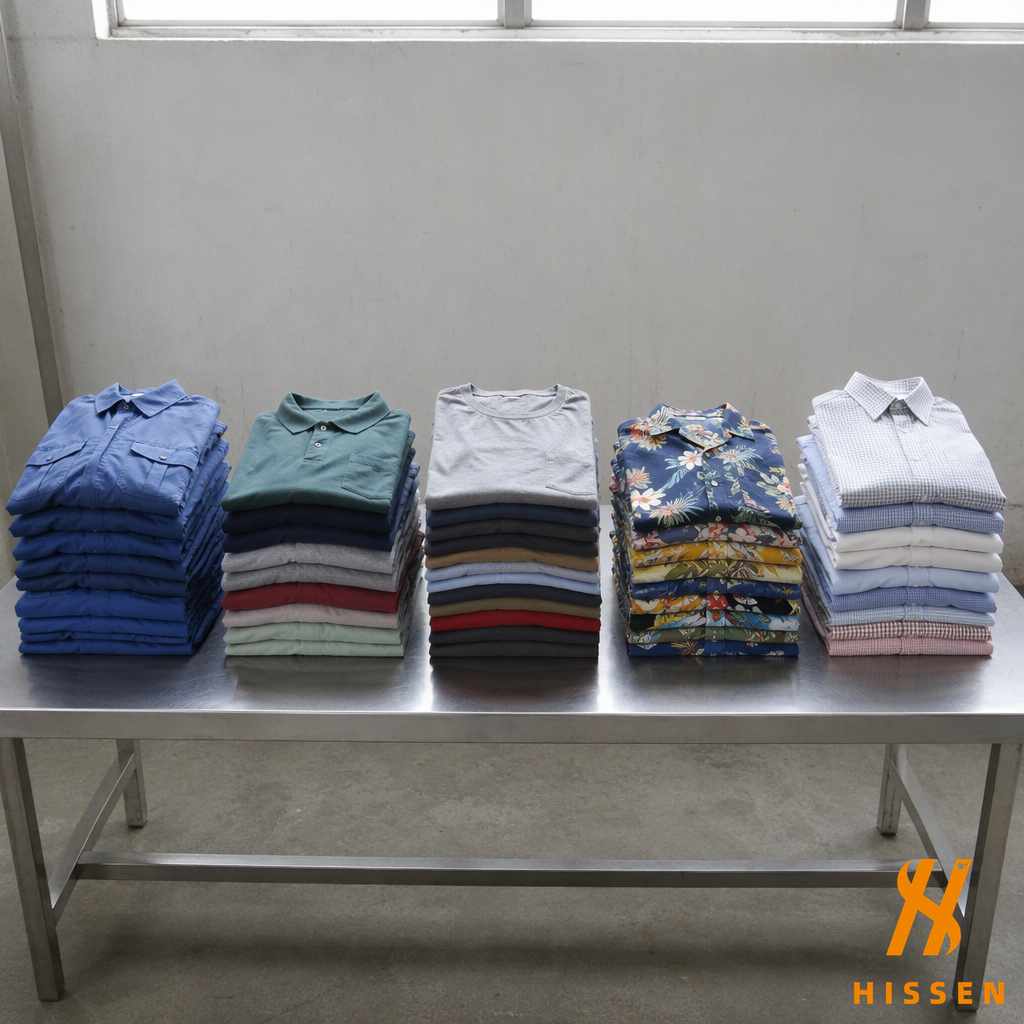
Most used shirts for sale in bulk arrive as a mixed load, and the first thing that mix hides is weight. A polo, a tee, a rugby shirt and a Hawaiian shirt are knits. A work shirt, a button-down and a flannel are wovens. That single difference reorganises every number in the order, because a knit weighs far less per piece.
A woven shirt averages about 0.30 kg. A piqué polo about 0.20 kg. A lightweight tee about 0.15 kg. So a 45 kg bale holds roughly 150 woven shirts, 225 polos, or 300 tees. Three quotations at the same price per kilogram are therefore three completely different prices per piece, and comparing them by the kilogram is comparing nothing.
The same fact runs the other way when you look at a container. Knits are bulky for their weight: a bale of tees occupies nearly the volume of a bale of work shirts at two-thirds of the mass. If freight is charged on volume rather than weight — which it often is on lighter categories — the per-piece freight on tees is not the bargain the weight suggests. Ask which basis the quotation uses before you compare two landed costs.
And it changes what “mixed” means. A mixed knit load is a mixed set of sizes of the same garment. A mixed woven load is a mixed set of garments. The first is usually fine for a shop; the second is what makes a category-quoted bale so unpredictable.
On a Knit, the Collar Is the Grade
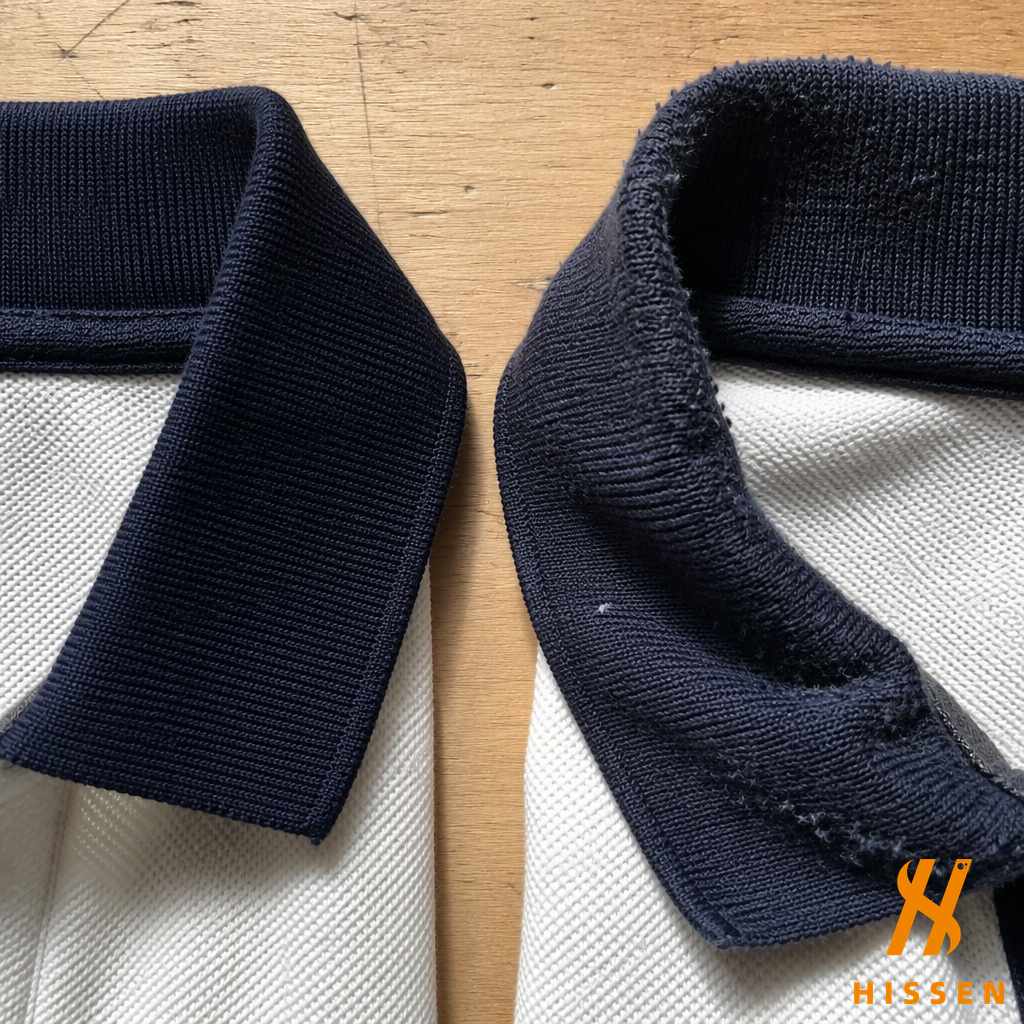
A woven shirt is graded by its fabric and its seams. A knit shirt is graded by its collar, and the collar fails years before the body does.
Three things happen to a knit collar, and they happen in a fixed order. First the rib relaxes: the elastane in the collar band loses recovery, so the collar opens and stops gripping. Then it curls — a collar whose rib has relaxed no longer holds its fold, so the points lift and the neckline gapes. Then the fold pills, because the collar is the one part of a knit shirt that is permanently creased and permanently rubbing against the neck.
The order matters commercially, because the three failures have different outcomes. A pilled collar can be shaved back and the shirt still sells at a lower price. A curled collar can sometimes be pressed flat and will hold for a few wears. A relaxed collar cannot be fixed at all: re-ribbing a collar is a factory operation, and on a used garment the cost exceeds the shirt’s value. So the acceptance rule is inverted from what most buyers assume — the collar test is pass or fail, and there is no negotiation in between.
The test is the same three seconds as the flannel nap test, in a different place. Hold the collar band between thumb and forefinger and stretch it across its width, then let go. It should snap back and sit flat. If it stays stretched, the rib is gone. Then fold the collar along its crease and look at the fold line: if the surface there is fuzzy and lighter than the rest of the collar, it has pilled and will look worn from three metres away.
One structural point saves money on the right stock. A knit collar is a separate piece, sewn on. That means it can be replaced — which is why rugby shirts with worn collars are a repair job rather than a write-off, and why a load of polos with sound bodies and dead collars is worth buying only if you have a repair line. Without one, a dead collar is a dead shirt, and the quotation should treat it that way.
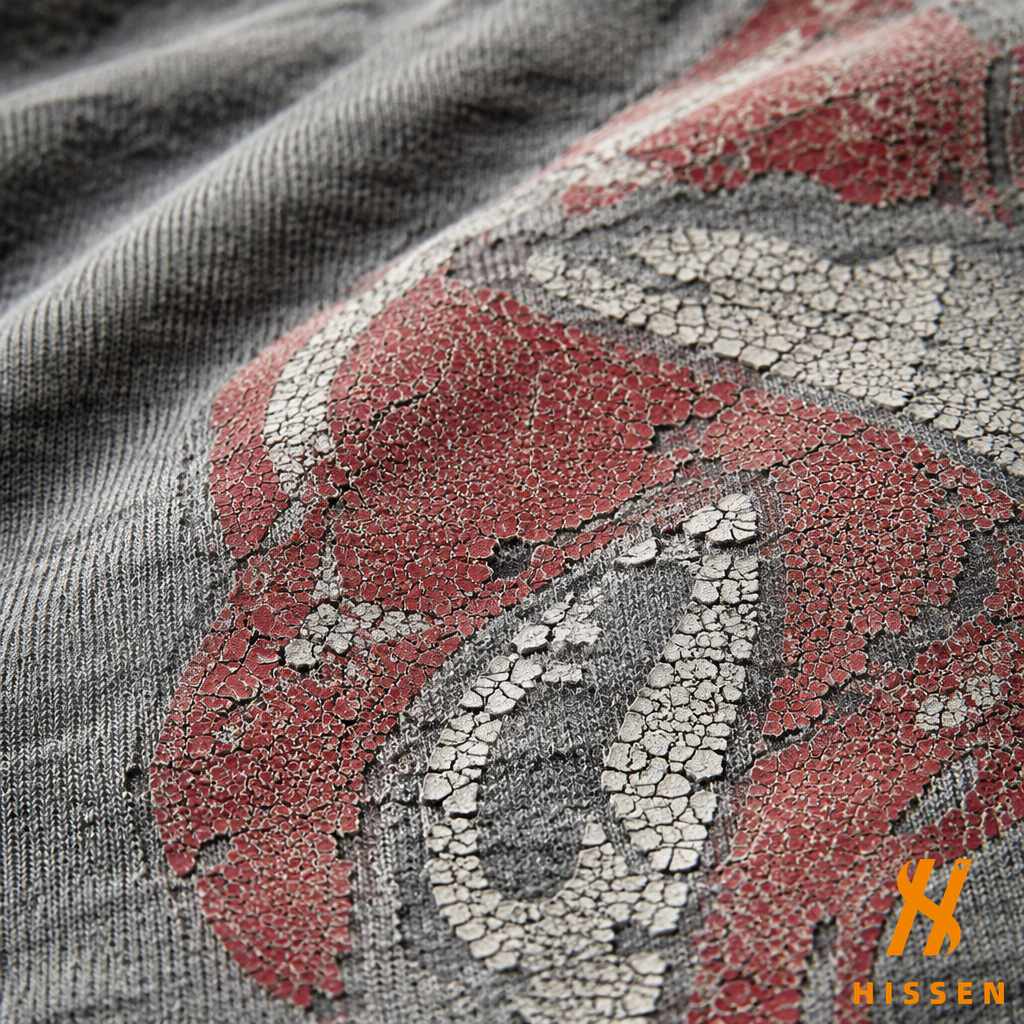
Print Fails in Four Ways, and Only One of Them Is Fatal
On any printed shirt, the print is a second material with its own failure mode, and the four methods behave so differently that the word “print” on an invoice tells you almost nothing.
Plastisol screen print is a layer of PVC ink sitting on the surface of the fabric. It is the most durable print in normal wear and the most spectacular in failure: when the elastic in the ink ages, it cracks along the fold lines and then flakes. A cracked plastisol print cannot be repaired, and a shirt with one is scrap regardless of how good the fabric is.
Water-based and discharge print dyes or stains the fibre instead of coating it. It feels softer, it does not crack, and it fades. In the used trade that fade is usually acceptable — a softly faded print reads as age, the same way a faded plaid does — which makes it the most forgiving method in a bale.
Heat transfer and vinyl sits on top and peels. A peeling transfer leaves a shiny adhesive ghost that cannot be removed without taking the colour with it.
Sublimation and direct-to-garment are the two people confuse. Sublimation dyes polyester at a molecular level: it never cracks and never peels, and it also cannot be removed, because the colour is the fibre. DTG lays ink on the surface of a cotton garment: it cracks like plastisol and cannot be removed either. Both are effectively permanent, which matters in the next section.
The practical consequence for an order is one line: ask what share of the printed pieces has cracking, peeling or a broken print, and whether that share is an exclusion or a discount. A supplier who can answer has looked at the prints. A supplier who says “all good condition” has looked at the pile.
The Removability Ladder for Identification
Shirts carry more branding than any other category in this trade, because a shirt is what a company puts its name on. The Hub calls identification the defining resale problem in shirts, and it is — but the useful version of that statement is a ladder, because branding is not one problem. It is five, ranked by whether you can get it off.
Embroidery is the best case. It can be unpicked. The shirt survives with a grid of needle holes that closes after one wash on a knit and stays faintly visible on a tight woven. Cost is minutes per piece, and it is the only method where the garment’s value after removal is close to the value it would have had unbranded.
Screen print is usually removable and never free. A solvent or a heat process lifts plastisol, but it lifts the garment’s dye with it at the edges, leaving a pale rectangle exactly where the logo was. On a dark shirt that rectangle is worse than the logo. On white and light colours it is often invisible after a wash, which is why plain white staff shirts with printed logos are the one identified category that reliably sells.
Heat transfer leaves a ghost. The vinyl peels, the adhesive does not, and the residue attracts lint permanently. Treat a transfer logo as permanent.
DTG and sublimation cannot be removed. DTG leaves a coloured shadow; sublimation has no separate layer to remove at all. A sublimated corporate polo is a finished garment with no second life.
This is the ladder to hold against an identification percentage. A load at 10% branding that is 8% embroidery and 2% print is a workable load. A load at 10% branding that is 6% sublimation is a 6% write-off, and a quotation that gives one percentage for both is hiding the difference.
Hawaiian and Golf Are Calendar Trades
The two largest slices in this cluster are the two least suited to a bale, and it is worth being direct about why, because those buyers are the majority of the search volume on this page.
A Hawaiian shirt is bought for an occasion. The occasion has a date: a festival, a cruise departure, a wedding rehearsal, a corporate summer party, a school event. An event buyer needs one colourway in a size spread by that date, and needs them identical, because a photograph of forty people in matching shirts is the product. Nothing about a sorted bale serves that. The sizes are mixed, the patterns are mixed, and the delivery date is a container schedule rather than a promise.
Golf shirts work the same way with a different motive. A tournament or a club needs plain colourways in a size run with a logo on the chest, and it needs them before the event. That is a decoration order, not a garment order: the shirt is a substrate and the print is the product. The cheapest golf shirt phrase in this cluster is really a question about decoration cost, and the answer sits with a blank-apparel distributor who can hold stock and print to a deadline.
What the used trade can do for those markets is different and smaller. In a sorted bale, aloha and polo shirts turn up as a small, high-margin slice — a used Hawaiian shirt in a strong print sells to a vintage buyer for more than its weight suggests, and used polos are the backbone of institutional outfitting in markets where a workplace supplies its own uniform. Both are worth buying. Neither is worth ordering by the event.
So the honest summary for an event buyer is the one at the top of this page: this is the wrong supplier, and the reason is the unit of sale rather than the quality of the goods. For a bale buyer, the two slices are simply the two most common knit categories in a mixed load, and they bring the collar and print rules above with them.
The Five Questions, and the One That Sorts the Rest
Used shirts for sale are quoted in a hundred ways, and the questions a supplier can answer cleanly separate the ones who handle stock from the ones who move it. These five are ordered so that each answer narrows the next, and the last one is deliberately not about the goods.
One: what is the knit-to-woven split? This fixes the piece count before anything else is discussed. A supplier who cannot give a split is selling a mixed pile.
Two: what share fails the collar test, and is that an exclusion or a discount? The question only makes sense to someone who has handled knits, and it is the fastest way to find out whether anyone has.
Three: what print methods are in the load, and what share has a broken print? Method matters more than count, because a faded water-based print is sellable and a cracked plastisol one is not.
Four: of the identified pieces, how much is embroidery and how much is sublimation? One number for branding is not an answer.
Five — and ask this last — which of these numbers is measured and which is estimated? Every supplier will have quoted four figures by now. The one who says “the split is measured, the print share is estimated from the top layer” is telling you exactly how much of the bale they opened. That answer is worth more than a discount, because it tells you which numbers to verify on arrival and which to accept.
What a Bale of Knit Shirts Actually Yields
The number that decides whether a load is worth buying is not the price per kilogram. It is the count of shirts that will clear a rail, and a knit load loses pieces in different places from a woven one.
Take a 45 kg mixed polo and tee bale at 0.20 kg average — 225 pieces — bought at $1.80 per kilogram, so $81 for the bale, and apply the losses in the order a shop meets them.
| Loss | Share of 225 pieces | Why it happens on a knit | Cost of missing it |
|---|---|---|---|
| Collar failure | 20% — 45 pieces | Rib loses recovery, then curls, then pills at the fold | Whole garment; no economic repair without a collar supply |
| Broken print | 12% — 22 pieces | Cracked plastisol or peeled transfer; invisible folded | Whole garment on the printed share |
| Identification | 14% — 22 pieces | Corporate and club marks; knits carry more than wovens | High, where the method is sublimation or transfer |
| Size orphans | 10% — 14 pieces | XS and 3XL concentrate in institutional overruns | Slow-moving stock, not loss |
| Holes, stains, side-seam twist | 8% — 10 pieces | Knit spirality after laundering; bleach spots | Whole garment |
| Sellable | 112 pieces — about 50% | Cost per sellable piece: $81 ÷ 112 = $0.72 | Against a $2–5 resale |
Half, and the same half for a different reason. On flannel the loss is the surface; on knits it is the collar and the print. What the arithmetic does show is why “cheap” dominates this cluster: at $0.72 per sellable piece against a $2 to $5 resale, a knit load has the best ratio in the shirt family, and the business is built on turning it rather than on pricing it up.
That ratio is the last thing to say about an order of used shirts for sale at any volume. On a knit load, the negotiation is not the price per kilogram — that moves by cents and the market already knows it. It is the size of the collar-failure share, and whether the print methods are separated in the invoice. A supplier who quotes both is selling you a specification. A supplier who quotes neither is selling you a weight.
For the categories, formats and per-kilogram ranges this page assumes, the wholesale shirts buying guide is the reference; the full used clothes range sits one level below it, and the format definitions are in our guide to bales of clothes. Buyers still assembling a shortlist rather than choosing between offers will get more from how to build and verify a clothing vendor list, and the grading vocabulary used above is set out in our guide to used wholesale clothing.
Frequently Asked Questions
How many shirts are in a 45 kg bale?
It depends on the knit-to-woven split, not on the bale weight. Woven shirts average about 0.30 kg, so roughly 150 pieces. Piqué polos average 0.20 kg, so about 225. Lightweight tees average 0.15 kg, so around 300. Comparing two quotations per kilogram without knowing the split compares nothing.
Why does a polo shirt fail at the collar first?
Because the collar is a ribbed band under permanent tension that is also permanently creased. The elastane in the rib loses recovery, the collar opens and stops gripping, then curls, then pills along the fold. The body can be perfectly sound while the garment is unsellable, and re-ribbing costs more than the shirt is worth.
Which shirt prints survive laundering?
Water-based and discharge prints fade but do not crack, and a soft fade is usually acceptable at resale. Plastisol screen prints crack and flake, and a cracked print is scrap. Transfers peel and leave an adhesive ghost. Sublimation never cracks but cannot be removed, and DTG cracks and cannot be removed either.
Can corporate logos be removed from used shirts?
Sometimes. Embroidery can be unpicked, leaving needle holes that close on knits and stay faint on tight wovens. Screen print can be lifted with solvent but usually takes the dye with it, which is why it works on white and fails on dark colours. Transfer, DTG and sublimation should be treated as permanent.
Are Hawaiian shirts worth buying in a bale?
As a slice, yes: strong prints sell to vintage buyers at a premium per piece. But check the fibre first. Rayon weakens sharply when wet and has low dimensional stability, so a rayon aloha shirt may not survive the laundering a resale requires. Cotton holds up and is worth more.
Is cheap bulk stock actually cheaper per shirt?
Rarely. Cheap stock carries the highest share of dead collars and cracked prints, so the cost per sellable piece can be higher than on a better-graded load at a higher price per kilogram. Calculate per sellable piece, not per kilogram.
Can I order matched shirts for an event from an exporter?
No. A sorted bale has mixed sizes and mixed patterns and ships on a container schedule. An event needs one colourway in a size spread by a date. That is a new-goods order with a decoration cost, and it belongs with a blank-apparel distributor rather than with a used-clothing exporter.
What is the single most useful question to ask a shirt supplier?
Ask which of their figures is measured and which is estimated. A supplier who says the knit-to-woven split is measured and the print share is estimated from the top layer has told you exactly how much of the bale was opened, and which numbers to verify on arrival.