What Are the Most Reliable Bulk Secondhand Clothes Exporters? A Complete Guide for South American & Asian Importers (2026)
⏱ 13 min read · For used clothing importers, wholesalers & trade buyers
In this guide you will learn:
- What defines a reliable bulk secondhand clothes exporter in 2026
- The key criteria for evaluating exporters from China, Europe, and the US
- A step-by-step supplier verification framework for new importers
- Current pricing benchmarks and market trends across South America, Africa, and Asia
- Why Hissen Global is positioned as a trusted partner for bulk buyers
The global trade in bulk secondhand clothes has grown into a multi-billion dollar industry. As an importer in South America, Africa, or Southeast Asia, your business depends on one critical decision: choosing the right exporter. But with hundreds of suppliers claiming to be "the most reliable," how do you separate genuine bulk secondhand clothes exporters from middlemen and opportunists?
In this comprehensive guide, written from the perspective of a Chinese exporter who has been serving international buyers for years, we answer that question directly. We will walk you through the criteria that define a truly reliable exporter, give you a verification framework you can use before placing your first order, and help you understand what the best suppliers do differently in 2026.
The days of blind trust in cross-border trade are over. Today's successful importers use data, verification, and partnership thinking to select bulk secondhand clothes exporters who deliver consistent quality, transparent pricing, and long-term value.
What Makes a Bulk Secondhand Clothes Exporter "Reliable"?
Before we identify specific exporters, let's define what reliability actually means in this industry. A truly reliable bulk secondhand clothes exporter demonstrates these five core qualities:
- 📄 Consistent Quality Grades — Their Grade A is always Grade A, not a mix of A and B. They have documented grading standards and will show you the difference between grades with real-time video.
- 📦 Reliable Supply Capacity — They can consistently fulfill orders of 1, 5, or 10+ containers per month without compromising on sorting quality or delivery timelines.
- 🔍 Transparent Operations — They welcome video calls, factory tours (in-person or virtual), and third-party inspections. No hidden areas, no excuses.
- 📊 Fair and Stable Pricing — Their prices reflect market realities, not opportunistic surges. They explain what you are paying for and why.
- 🤝 Long-Term Partnership Mindset — They invest in your success with market insights, quality improvements, and responsive communication.
💡 Industry insight: According to the Bureau of International Recycling (BIR), the used textiles trade exceeded 5.5 million tonnes globally in 2025, with China, the US, Germany, the UK, and South Korea being the largest re-export hubs. Among these, China has emerged as the preferred sourcing destination for importers in South America and Southeast Asia due to competitive pricing, extensive sorting capabilities, and shorter shipping routes to the Asia-Pacific region.
The 2026 Landscape: Where Do Reliable Exporters Operate?
The bulk secondhand clothes export market is concentrated in a few key regions. Each has its strengths and considerations for importers:
| Export Hub | Key Strengths | Best For | Considerations |
|---|---|---|---|
| 🇨🇳 China (Guangzhou) | Largest sorting capacity; competitive pricing; diverse source mix; flexible MOQ; strong seasonal sorting | South America, Africa, SEA, Middle East | Requires thorough vetting — quality varies between exporters |
| 🇺🇸 USA | Premium quality original garments; well-established collectors | Premium markets, Grade A buyers | Higher pricing; limited sorting customization; longer shipping to Asia |
| 🇩🇪 Germany / Europe | High-quality source material; strict environmental standards | European-quality Grade A/B buyers | Premium pricing; smaller bale sizes; longer lead times |
| 🇰🇷 South Korea | Trendy Asian fashion; lightweight summer garments | Southeast Asia, Pacific Islands | Limited volume; higher per-kg pricing; niche categories only |
| 🇯🇵 Japan | Excellent condition; premium brand items; meticulous sorting | Premium used clothing retailers | Very limited bulk supply; premium pricing; strict export regulations |
🔥 Key insight for 2026: China has consolidated its position as the world's largest bulk secondhand clothes exporter to South America and Asia. The combination of large-scale sorting infrastructure, access to global source materials (Europe, US, Korea, and domestic collections), and competitive logistics costs makes Chinese exporters the default choice for volume buyers. However — and this is critical — not all Chinese exporters are created equal. The industry ranges from highly professional operations with 20+ years of experience to small workshops with inconsistent quality.
6-Step Framework: How to Verify a Reliable Bulk Secondhand Clothes Exporter
This is the most practical section of this guide. Use this 6-step verification framework to evaluate any bulk secondhand clothes exporter before committing to your first order:
Step 1: Check Operational History & Export Records
A reliable exporter should have a verifiable track record. Ask for:
- Business license and export registration documents
- Shipping records (bill of lading copies) for previous shipments to your region
- Customer references — ideally from importers in similar markets to yours
- Years of operation (look for 3+ years minimum; 5-10+ is a strong sign)
✅ Red flag: An exporter who cannot or will not provide verifiable export records. If they have been operating for "many years" but cannot show you proof, proceed with caution.
Step 2: Request Detailed Product Specifications
A reliable bulk secondhand clothes exporter can describe their products with precision:
- Exact bale weight (typically 45-50 kg compressed)
- Category breakdown per bale (e.g., T-shirts 30%, jeans 20%, dresses 15%, etc.)
- Grade definitions with visual examples (photos/videos of Grade A vs Grade B)
- Seasonal composition (summer vs winter percentages)
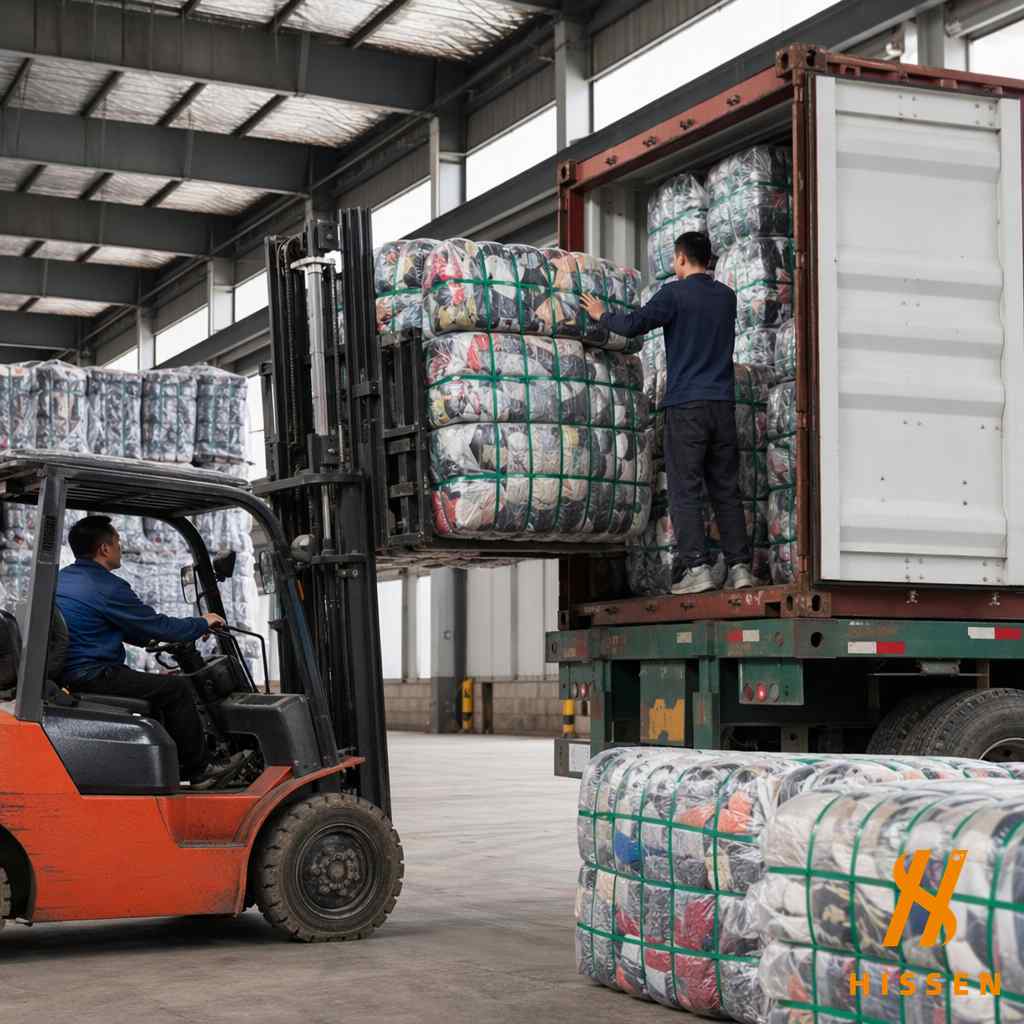
- Packaging and container loading method
✅ What to look for: Clear, written specifications with supporting visual evidence. Vague descriptions like "good quality mixed bales" without details are not acceptable.
Step 3: Demand Visual Verification (Video Tour)
In 2026, there is no excuse for buying sight unseen. Insist on:
- A live video call walking through the warehouse, sorting line, and baling area
- Real-time video of the specific bales being prepared for your order
- Photos and videos of the current inventory, not "outdated photos" from last year
🔥 Best practice: The most reliable bulk secondhand clothes exporters today offer regular video updates throughout the sorting and loading process. This transparency is the hallmark of a professional operation.
Step 4: Understand the Pricing Structure
Here are 2026 benchmark price ranges for bulk secondhand clothes from Chinese exporters, FOB Guangzhou:
| Grade | Category | Price Range (FOB, per kg) | Typical Order Size |
|---|---|---|---|
| Grade A Premium | Mixed sorted (seasonal or mixed-season) | $2.50 – $4.00/kg | 1 × 40HQ container |
| Grade B Standard | Mixed sorted | $1.40 – $2.20/kg | 1 × 40HQ container |
| Grade A by Category | Single-category (e.g., T-shirts only, jeans only) | $3.50 – $5.50/kg | 1–5 containers |
| Shoes Bales | Mixed or sorted shoes | $2.00 – $4.00/kg | 1 × 40HQ container |
| Winter Wear | Jackets, coats, sweaters (sorted) | $3.00 – $5.00/kg | 1 × 40HQ container |
⚠️ Note: Prices significantly below these ranges should raise suspicion. A genuine Grade A bale at $1.20/kg does not exist in the current market. If the price is too good to be true, the quality — or the delivery — will almost certainly be compromised.
Step 5: Evaluate Communication and Responsiveness
Communication quality is a leading indicator of operational reliability. A reputable bulk secondhand clothes exporter will:
- Respond to inquiries within 24 hours (typically much faster on WhatsApp/WeChat)
- Answer specific questions directly and provide evidence
- Speak good English (or provide a capable interpreter)
- Proactively update you on order status, shipping schedules, and any changes
- Offer market insights and advice — not just take orders
✅ What to look for: If communication is slow, vague, or evasive before you place an order, it will not improve after you pay.
Step 6: Request a Bulk Order Pilot
Before committing to a large volume contract, a reliable exporter will work with you on a pilot order:
- Start with 1 × 40HQ container to evaluate quality, sorting accuracy, and delivery
- Inspect the bales upon arrival in your country (with photos/video evidence)
- Provide feedback to the exporter — a reliable partner will use this to improve the next shipment
- Scale up gradually based on proven performance, not promises
📌 Remember: A truly reliable exporter welcomes the pilot approach because they are confident in their product. It is the unreliable ones who push for large commitments upfront.
Common Mistakes When Choosing Bulk Secondhand Clothes Exporters
Having worked with dozens of importers, here are the 5 most common mistakes we see — and how to avoid them:
- ❌ Choosing based on price alone — The cheapest bulk secondhand clothes exporter is rarely the most reliable. A $0.30/kg saving can cost you thousands in unsold inventory, quality disputes, and delayed shipments.
- ❌ Skipping the verification process — Because you are "in a hurry" or the supplier "seems professional." Always verify. Always ask for video. Always check references.
- ❌ Not specifying quality expectations in writing — Verbal agreements about grade, category mix, and seasonality are not enforceable. Put everything in the contract or purchase order.
- ❌ Ignoring shipping and logistics alignment — A reliable exporter helps you plan shipping so your container arrives during your peak selling season. An unreliable one ships whenever it is convenient for them.
- ❌ Treating the first order as the last test — Reliability is proven over multiple shipments, not one. Build a relationship with an exporter who sees you as a long-term partner, not a one-time transaction.
Why Hissen Global Is Positioned as a Reliable Bulk Secondhand Clothes Exporter
As a China-based exporter serving markets across South America, Africa, and Asia, Hissen Global has built its reputation on the principles outlined in this guide. Here is how we measure up against the criteria of a reliable bulk secondhand clothes exporter:
- 📜 Verifiable Track Record — We have years of operational history with verifiable export documentation and references from importers across multiple continents.
- 🏭 Transparent Operations — Our facility in Guangzhou is open for live video tours. You can see our sorting lines, our inventory, and our team — before you place an order.
- 📊 Consistent Quality Grading — We use documented multi-stage sorting with clear Grade A, Grade B, and category separation. What we describe is what you receive.
- 🌍 Market-Specific Knowledge — We understand the seasonal, cultural, and regulatory requirements of importing used clothing into South America, Africa, and Southeast Asia. This knowledge translates into better bale compositions for your market.
- 💬 Responsive Communication — Our team responds promptly, answers questions directly with evidence, and provides proactive updates throughout the order process.
- 🤝 Partnership Over Transaction — We invest in our clients' success by sharing market data, pricing intelligence, and category insights. Your growth is our growth.
💡 Key Takeaways
- Reliability in bulk secondhand clothes exporting is defined by consistency, transparency, and partnership thinking — not just low prices
- China is the leading export hub for South American and Asian importers, but vetting individual exporters is essential
- Use the 6-step verification framework: check history, ask for specs, demand video, understand pricing, evaluate communication, start with a pilot
- Cross-check prices against 2026 benchmarks — below-market pricing is a major red flag
- A pilot container order is the safest way to evaluate a new exporter's reliability
- Hissen Global meets the criteria of a reliable bulk exporter with verifiable experience, transparent operations, and market-specific expertise
Frequently Asked Questions
1. Which country exports the most bulk secondhand clothes?
China is the world's largest exporter of bulk secondhand clothes by volume, followed by the United States, Germany, the United Kingdom, and South Korea. China's dominance is driven by its massive sorting infrastructure in Guangdong Province, access to source materials from multiple countries, and competitive shipping rates to South America, Africa, and Asia.
2. How do I verify a Chinese bulk secondhand clothes exporter?
The most effective method is a combination of: requesting their business license and export documentation, asking for shipping records to your region, conducting a live video tour of their facility, contacting their existing clients for references, and starting with a pilot container order before scaling up.
3. What is the minimum order quantity for bulk secondhand clothes from reliable exporters?
Most established bulk secondhand clothes exporters in China require a minimum of 1 × 40HQ container (approximately 250-300 bales, weighing 12,000-15,000 kg). Some mid-sized exporters may offer 20FT containers (half-volume) for new clients, though the per-kg pricing is typically higher for smaller orders.
4. How much does a container of bulk secondhand clothes cost in 2026?
FOB China pricing for a 40HQ container ranges from approximately $18,000–$45,000 depending on grade, category mix, and seasonal sorting requirements. Grade A mixed bales typically cost $2.50–$4.00/kg, while Grade B ranges from $1.40–$2.20/kg. Always request a detailed FOB quotation that includes bale count, weight, and grade composition.
5. What is the difference between Grade A and Grade B in bulk secondhand clothes?
Grade A contains near-new garments with minimal wear (typically 80-90% sellable as premium second-hand items), current styles, and no major defects. Grade B includes items with visible wear, older styles, or minor flaws — still sellable but typically in lower-price markets. Grade A commands a 40-70% price premium over Grade B because of higher per-item retail value.
Build a Relationship with a Reliable Exporter
The bulk secondhand clothes industry offers tremendous opportunities for importers in South America, Africa, and Asia — but only if you work with the right partner. By using the framework in this guide, you can avoid the common pitfalls that trap new importers and build a sourcing relationship that grows with your business.
At Hissen Global, we believe that reliability is earned through consistent action, not claimed through marketing words. We invite you to put us to the test: request a video tour, check our specifications against the benchmarks in this guide, and see for yourself what a reliable bulk secondhand clothes exporter looks like.
📦 Ready to work with a verified bulk secondhand clothes exporter? We invite you to compare before you decide.
Hissen Global is a China-based exporter specializing in Grade A and Grade B used clothing bales for South America, Africa, and Asia. With transparent operations, consistent quality, and market-specific expertise, we are built for importers who demand reliability.
📞 Request Pricing & Live Video Tour →
✅ Prefer to learn more first? Browse our industry guides for free insights on used clothing importing, grading, and supplier selection.