Used shoes wholesale is one of the most durable categories in the global second-hand trade — and one of the hardest to buy well. Unlike new footwear, where a specification sheet tells you exactly what you are paying for, a container of used shoes wholesale is a statistical product: the same grade name can deliver 65% wearable branded sneakers from one sorting floor and 65% unsellable singles from another. The difference is rarely the price. It is the grading discipline behind the bale.
This guide covers what you will actually be quoted — the shoe categories, the grades, the packing units, the price bands per kilogram and per container — and the vetting steps that decide whether the container you receive matches the one you paid for.
⏱ 9 min read · For importers, wholesalers & trade buyers
In this guide you will learn:
- The eight shoe categories you will be quoted, and which ones carry the least risk
- How A / B / C and cream grading is actually applied on a sorting floor
- Realistic price bands per kg, per bale and per 40ft container
- A seven-point supplier vetting checklist that prevents grade substitution
What Counts as Used Shoes Wholesale?
In trade terms, used shoes wholesale means footwear collected, sorted and resold in bulk — never as individual pairs to end consumers. The supply chain runs from collection bins and charity drive networks in North America, Europe, Japan and South Korea, through regional sorting facilities, into export bales and containers. Wholesale buyers sit at the end of that chain: you buy by weight or by bale, and you resell by the pair.
The critical distinction is between sorted and unsorted goods. Unsorted footwear — often described as mixed shoes or mix bales — has been baled by origin and weight but not graded pair by pair. Sorted footwear has moved across a belt where operators pull it into categories and grades. Sorted goods cost more per kilogram, but the resale spread is far more predictable, which is why most importers who resell into retail stalls eventually move to sorted supply.
The Main Categories of Wholesale Shoes
Buyers who ask simply for “shoes” get whatever the seller wants to move. Serious wholesale buying starts by naming the category, because category determines both the price band and the resale audience.
Mixed shoes (mix bales)
Everything in one bale: men’s, women’s, children’s, sandals, formal, athletic, boots. The cheapest entry point per kilogram and the highest variance. Mix is the right product only if your buyers are themselves market resellers who enjoy sorting, not if you are stocking a shop.
Branded used shoes
Footwear carrying a recognisable mark — sportswear, casual and fashion brands. Branded goods are pulled out of the mix because brands carry a premium in almost every destination market. Within branded supply, the sharpest split is between mixed brands (whatever marks are present) and target brand lists, where a buyer names the brands they will accept. See our used brand shoes category for how this is packed for export.
Athletic and sneaker bales
Sneakers dominate demand in most young-consumer markets. They are also the category most frequently misrepresented, because “sneaker bale” is used loosely to describe any athletic-style footwear including worn-out training shoes. Ask for the proportion of running versus lifestyle silhouettes.
Boots and winter footwear
Seasonal, bulky and heavier per pair, but with strong margins in cold-climate and highland markets. Winter boots are best bought in a single consolidated shipment timed to arrive before the season, not spread across the year.
Children’s and ladies’ footwear
Children’s shoes turn over faster than any other segment, and ladies’ footwear offers the widest style variety — and the widest quality spread. Both reward buying from suppliers who will specify the gender and age split rather than shipping a general mix.
Leather, formal and specialized footwear
Leather shoes, school shoes, safety and work footwear, and skate or specialty items. Smaller volumes, less competition, and generally purchased by buyers with an established niche rather than as a general line.
Washed and cleaned shoes
Footwear that has been laundered or cleaned and finished before baling. It costs more, but it arrives shelf-ready and photographs well — a meaningful advantage for sellers using e-commerce or social commerce rather than physical markets.
How Used Shoes Are Graded
Grade names are not a global standard, and this is the single largest source of disputes in the trade. Two suppliers can both say “Grade A” and mean entirely different things. What follows is how the terms are normally applied — always confirm the definition in writing before ordering.
| Grade | Condition | Typical yield when re-sold by the pair |
|---|---|---|
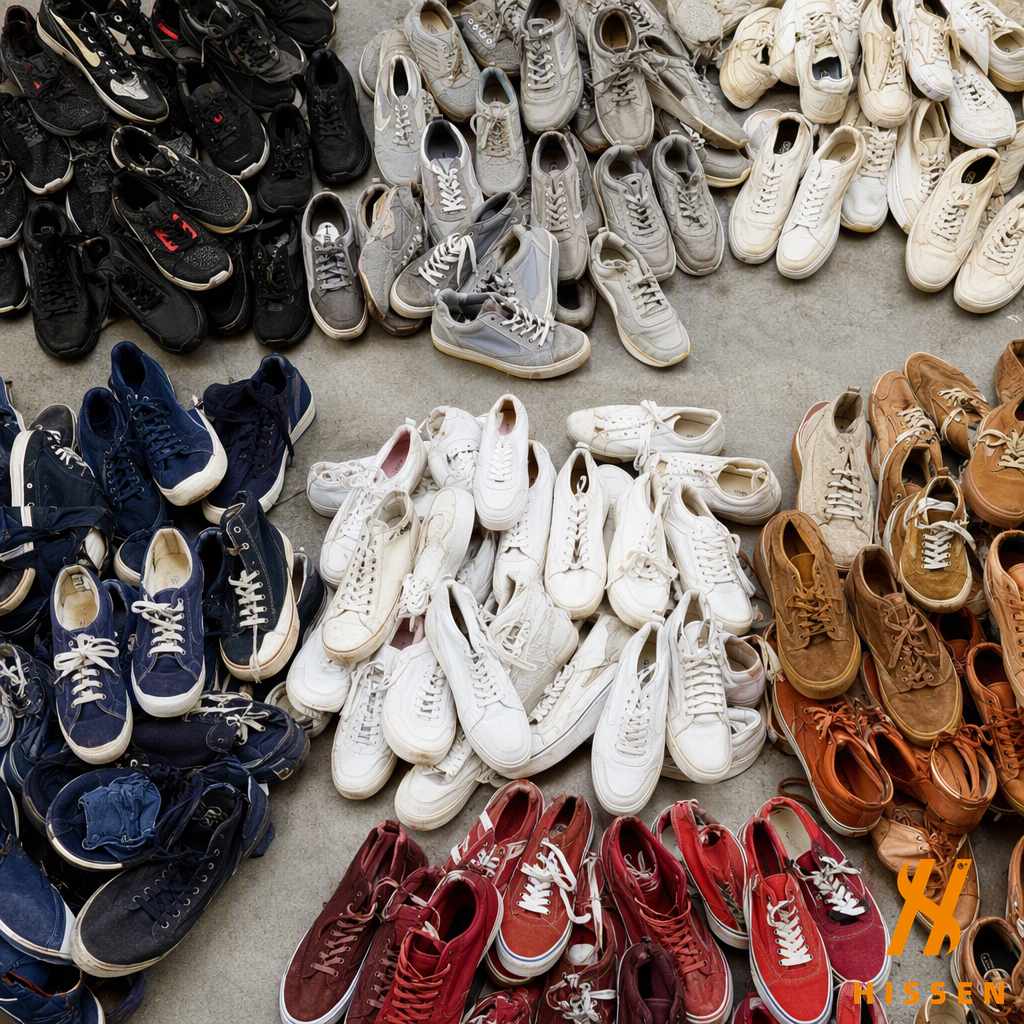
| Cream grade | Best available selection; near-new appearance, premium brands, minimal wear, often cleaned | Highest per-pair price; small volumes only |
| Grade A | Lightly worn, structurally sound, soles intact, minimal visible defect | Strong; the workhorse grade for shop retail |
| Grade B | Clearly worn but fully wearable; scuffs, faded colour, some sole wear | Good volume; the standard grade for market stalls |
| Grade C | Heavily worn, cosmetic damage, occasionally needing repair | Low per-pair; viable only at very low cost per kg |
Two practical points. First, grading is done fast, by hand, by operators who process a high volume per shift — so “Grade A” describes an average, not a floor. Second, the real quality signal is the singles ratio: the share of shoes with no matching partner. Singles are close to unsellable and they are the hidden cost in a cheap bale. A Grade A bale at a higher price with a 5% singles ratio will outperform a cheaper bale with 25%.
Where Wholesale Shoes Come From: B2B Channels
There are four realistic sourcing channels, and they differ far more in risk than in price.
- Sorting houses and graders of origin — facilities in the USA, Europe, Japan and Korea that grade before export. Highest traceability, most transparent grading, highest cost per kg.
- Export trading companies — intermediaries who buy graded or ungraded bales and consolidate for export. The most common channel for first-time importers, and the one where grade substitution is most frequent.
- B2B marketplaces and trade shows — online wholesale platforms and second-hand textile trade fairs. Useful for price discovery and for finding names to vet; weak on enforceable quality specifications.
- Direct factory and warehouse supply — buying at the sorting facility, often with the option to inspect before loading. This is the model that removes the most uncertainty, because the goods never leave the building before you have seen them.
For most buyers the practical answer is a hybrid: establish the specification with a source that controls its own sorting floor, and use marketplace quotes only as a price ceiling.
2026 Market Overview
Second-hand apparel and footwear has moved from a charity-adjacent sideline to a mainstream trade category. Industry analysts at ThredUp have tracked global resale growing several times faster than the conventional apparel market for a decade, and Textile Exchange’s materials reporting shows recycled and second-hand fibre taking a steadily larger share of total textile volume. Footwear follows the same curve with a lag, because used shoes are harder to sort and heavier to ship than clothing.
On the demand side, the established import markets remain East Africa — Kenya, Uganda and Tanzania, where the sector is a major employer and a politically sensitive one — alongside Ghana, Nigeria, Chile’s free zone as the gateway to South America, and the Middle East and Southeast Asia. On the supply side, tighter collection and export controls in several European countries, plus continued scrutiny of the trade in East Africa, have kept origin volumes firm and prices range-bound rather than falling.
Two structural pressures are worth planning around. Freight rates on the main container routes remain volatile, and because used shoes are a low-value-per-tonne commodity, a freight spike hits footwear imports harder than almost any other category. And destination-market regulation keeps tightening — a growing number of countries now require pre-shipment inspection, fumigation certificates or specific permits for second-hand textile and footwear imports. Confirm the current requirements for your own destination before you book, not after.
Wholesale Shoe Prices: Per Kg, Per Bale, Per Container
Prices move with origin, grade, brand content and freight, so treat the bands below as orientation rather than a quotation. The structural point is the ratio between them: sorted branded footwear costs several times more per kilogram than unsorted mix, and it earns more than several times more when resold by the pair. Unbranded mix is not “cheaper product” — it is a different business model.
| Category | Packing unit | Relative cost per kg | Best suited to |
|---|---|---|---|
| Mixed unsorted shoes | 45–100 kg bales | Lowest | Market resellers who sort themselves |
| Sorted mix shoes (Grade B) | 45–100 kg bales, or per kg | Low–mid | Volume market stalls |
| Sorted mix shoes (Grade A) | Per kg | Mid | Shop and stall retail |
| Branded used shoes (mixed brands) | Per kg, or per pair | Mid–high | Branded shops, e-commerce |
| Target-brand selections | Per pair | High | Specialist and online resellers |
| Washed / cleaned branded shoes | Per pair | Highest | E-commerce and social commerce |
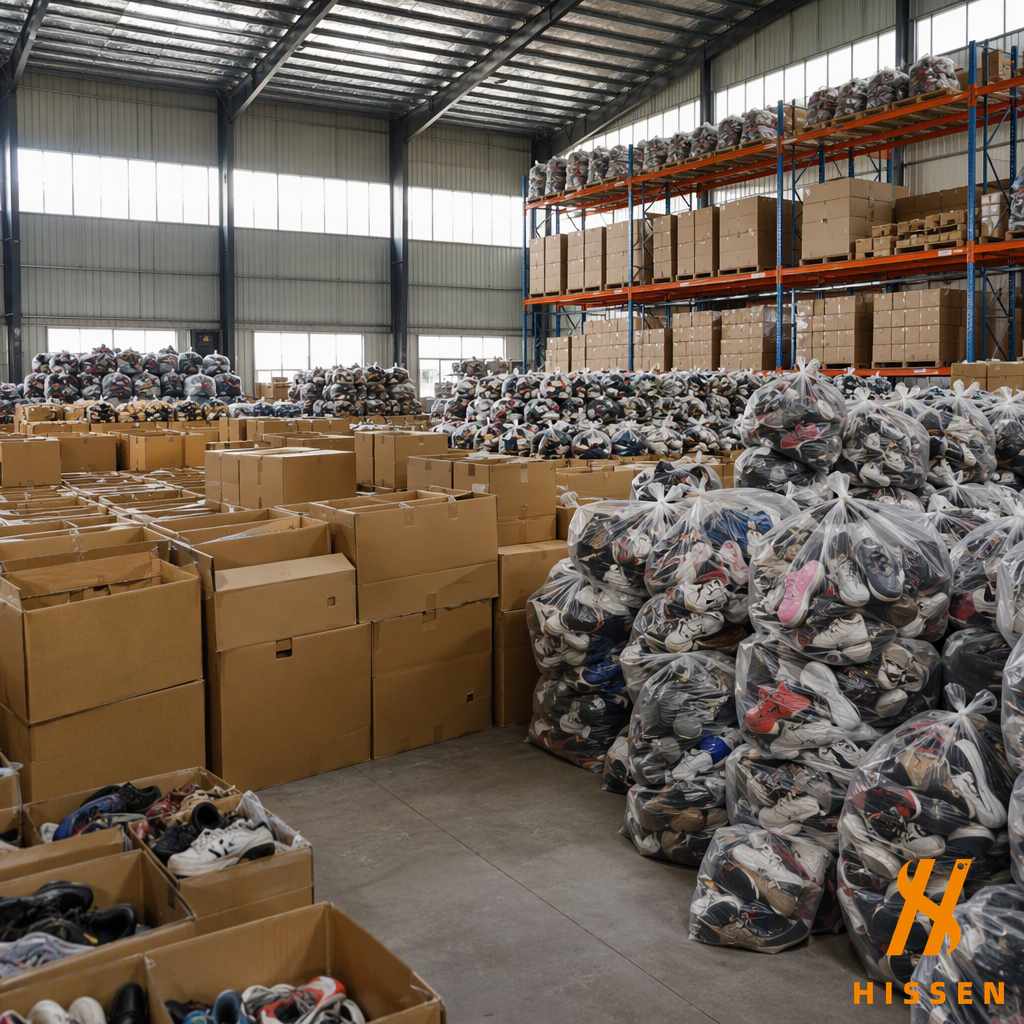
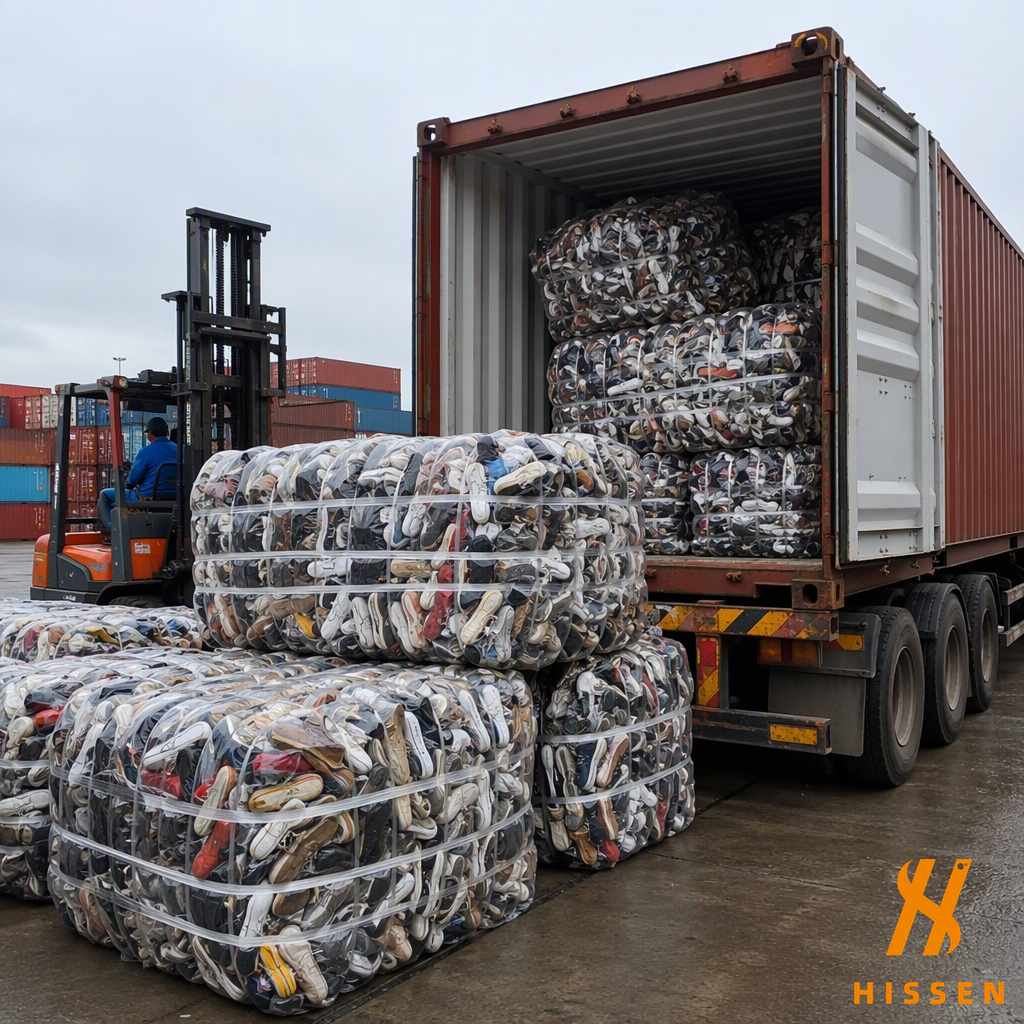
On volume: a 40ft high-cube container typically loads in the region of 20–28 tonnes of baled footwear, depending on bale density and how the load is built. Always ask for the loading weight you are paying for, in kilograms — not “a full container” — and ask for the loading photographs and the packing list with bale counts and weights.
How to Choose a Used Shoe Wholesale Supplier
Use the same checklist for every supplier, in this order. The point is not to find the cheapest quote; it is to find the supplier whose process makes the quote meaningful.
- Grade definition in writing. Ask what Grade A means to them specifically: acceptable sole wear, singles ratio ceiling, cleaning standard, brand policy. A supplier who cannot answer this in numbers is a trader, not a grader.
- Loading evidence. Loading photographs, bale weights and container numbers. Photographs that show the goods clearly inside the container — not stock imagery of a warehouse.
- A live video walkthrough. A scheduled video call through their sorting floor and warehouse, on their premises, at your request. This is the single most useful vetting step available, and the one most suppliers will resist.
- Trade references in your market. A reference in a comparable destination market tells you what the goods actually looked like on arrival.
- Destination-requirement awareness. A good supplier asks you about import permits and inspection requirements for your country before quoting. If they do not, they have shipped to your market either never or carelessly.
- Payment terms that protect you. Standard practice is a deposit against a balance on documents, but the specification should be an annexe to the contract — grade, singles ratio ceiling, bale weights, total kilograms, brand policy — so that a shortfall is a contract breach and not a disagreement.
- Loading, not promising. The order is only as good as the loading. Insist on the inspection or the video verification happening at loading, before the container doors are sealed.
Common Mistakes to Avoid
- Buying on price per kilogram alone. The cheapest bale is usually the one with the most singles, the most Grade C leakage and the most unusable pairs. Cost per sellable pair is the only meaningful number.
- Accepting verbal grade definitions. If the grade is not written into the order, you have bought a bale of hope.
- Ordering a full container before a smaller trial load. Start with a volume you can absorb, sell it, and let the results decide the container. This is standard practice and any supplier worth using will support it.
- Ignoring the singles ratio. Ask for it as a percentage. Refusal to discuss it is an answer in itself.
- Forgetting the destination side. Permits, pre-shipment inspection and port procedures can hold goods longer and cost more than the goods themselves. Understand your own import regime before you commit.
- Assuming brand lists are honoured automatically. If you specified brands, verify against the packing list at loading, not at destination.
💡 Key Takeaways
- Category and grade are the two decisions — everything else is logistics. Naming the category and writing the grade definition down prevents most disputes.
- Sorted beats unsorted as soon as you retail by the pair. The premium per kg is smaller than the premium you recover in sellable yield.
- The singles ratio is the hidden cost in every cheap bale. Ask for it as a number.
- Volume is quoted in kilograms, not “containers”. A 40ft high-cube loads roughly 20–28 tonnes of baled footwear.
- Verify at loading, not at destination. Once the doors are sealed, your leverage is gone.
Frequently Asked Questions
How much does used shoes wholesale cost per kilogram?
Prices depend on origin, grade, brand content and freight, and they move with the market. The reliable rule is the ratio: unsorted mix is the cheapest per kilogram, sorted mix sits in the middle, and branded or cleaned footwear costs several times more — while also reselling for several times more per pair. Ask any supplier for a live quotation against a written specification rather than a headline price.
What is the difference between Grade A and Grade B used shoes?
Grade A normally means lightly worn, structurally sound footwear with intact soles and minimal visible defect. Grade B means clearly worn but fully wearable, with scuffs, faded colour or sole wear. Because there is no universal standard, the definition must be agreed in writing — and the singles ratio matters more than the label.
How many pairs of shoes are in a 40ft container?
A 40ft high-cube container typically carries around 20–28 tonnes of baled footwear. Pair counts vary widely with shoe type, since children’s sandals and men’s work boots differ enormously in weight. Ask for the loading weight in kilograms and the bale count rather than a pair estimate.
Should I buy sorted or unsorted used shoes?
Buy unsorted mix only if you or your buyers are willing to sort and accept the loss on unsellable pairs. If you sell by the pair into shops or online, sorted and graded supply will return more per kilogram despite the higher purchase price.
What should I check before importing used shoes?
Confirm your destination country’s current rules first — many markets require permits, pre-shipment inspection or fumigation certificates for second-hand textile and footwear imports, and enforcement changes. Then confirm the grade definition, the singles ratio, the loading weight and the payment terms in writing before the container is loaded.
Why Buy Used Shoes Wholesale from Hissen Global
Hissen Global is a China-based exporter of second-hand clothing, shoes and bags, supplying importers, wholesalers and market resellers across Africa, Latin America, Asia and the Middle East. Our sorting and grading lines are under our own control, which means the grade you are quoted is a process we run rather than a label we apply — and it is documented in our quality standards.
Practical advantages for trade buyers:
- Category-level specification. Order by category — mixed, branded, athletic, boots, children’s, ladies’, leather, or washed — rather than accepting a general mix.
- Loading photographs and packing lists with bale counts and weights for every shipment.
- Live video inspection of the goods at loading, on request.
- Consolidation — combine shoe categories with used clothing and bags in one container to reduce freight cost per tonne.
- Destination experience. We ship regularly into African, Latin American and Asian markets and will flag the import requirements we have seen enforced.
Get Your Quote
Evaluating used shoes wholesale suppliers? We invite you to compare before you decide. Send us your destination market, the categories you want, and your target volume in kilograms — and we will come back with a specification and pricing you can hold us to.
Hissen Global is a China-based exporter of second-hand clothing, shoes and bags, working with importers and wholesalers across Africa, Latin America, Asia and the Middle East. Browse our full used shoes range or start with our most-requested lines: mixed shoe bales and branded used shoes.