What Wholesale Secondhand Apparel Companies Offer Factory-Direct Container Pricing? (2026 Guide)
⏱ 13 min read · For used clothing importers, wholesalers & trade buyers
In this guide you will learn:
- What factory-direct container pricing means for secondhand apparel importers
- Which wholesale secondhand apparel companies offer true factory-direct pricing
- How to calculate the real cost of a container from China in 2026
- A step-by-step framework to verify factory-direct claims and avoid middlemen
- Why Hissen Global offers transparent factory-direct pricing for importers worldwide
For importers of wholesale secondhand apparel in Africa, South America, and Southeast Asia, one question consistently determines business success: "Are we getting factory-direct pricing, or are we paying for middlemen?"
The difference between factory-direct container pricing and broker-marked-up pricing can be $3,000-$8,000 per container — enough to determine whether your import business is profitable or just breaking even. In this guide, written from the perspective of a Chinese exporter, we identify which wholesale secondhand apparel companies offer genuine factory-direct pricing, how to verify their claims, and what to expect when you buy directly from the source.
Understanding the distinction between a genuine exporter (who owns or operates sorting facilities) and a trading company (who sources from multiple factories) is the single most important step in optimizing your procurement costs.
What Is Factory-Direct Container Pricing?
Factory-direct container pricing means that the price you pay for a container of secondhand apparel comes directly from the company that sorted, graded, and baled the products — with no intermediary layers adding margins.
In the used clothing industry, the supply chain typically looks like this:
- 🔹 Factory Direct (1 layer) — Collection/Sorting/Export facility → You (importer). Pricing includes only sorting + logistics + exporter margin.
- 🔹 Trading Company (2-3 layers) — Collection → Sorting facility → Trading company → You. Each layer adds 5-20% margin.
- 🔹 Multi-Broker Chain (3+ layers) — Multiple intermediaries between the factory and you. This is the most expensive option.
A genuine wholesale secondhand apparel company offering factory-direct pricing typically owns or operates its own sorting facility, directly purchases source materials, and manages its own export logistics. They do not buy from other sorters and resell — they sort, grade, and export their own products.
💡 Why this matters: Importers who work with factory-direct exporters report average cost savings of 15-30% per container compared to working through brokers or trading companies, according to industry surveys by the International Textile Recycling Association.
Which Wholesale Secondhand Apparel Companies Offer Factory-Direct Pricing?
The wholesale secondhand apparel market features several types of companies. Here is how they compare on factory-direct pricing:
| Company Type | Owns Sorting Facility? | Pricing Layer | Typical Margin Added | Best For |
|---|---|---|---|---|
| Factory-Direct Sorters (Guangzhou) | ✅ Yes | Direct (1 layer) | 0% intermediary | Volume buyers seeking best FOB pricing |
| Full-Service Exporters with Own Sorting | ✅ Yes (partially or fully owned) | Direct (1 layer) | 0-5% service fee | Importers wanting end-to-end service + direct pricing |
| Trading Companies | ❌ No (source from factories) | 2 layers | 10-25% | Small orders or multi-category sourcing from one contact |
| Online Marketplaces / Platforms | ❌ No | 2-3 layers | 15-40% | First-time buyers exploring options |
The majority of factory-direct wholesale secondhand apparel companies are located in Guangzhou and surrounding cities in Guangdong Province, China. This region has the world’s highest concentration of used clothing sorting facilities, with the largest operations sorting 50-100+ containers per month.
🔥 Key insight: Not every company that claims "factory-direct" actually is. Some trading companies acquire a small sorting facility or partner with one factory and market themselves as factory-direct. The only way to verify is to ask the right questions — which we cover in the next section.

5-Step Framework: How to Verify Factory-Direct Container Pricing
Use this 5-step framework to determine whether a wholesale secondhand apparel company is truly offering factory-direct pricing:
Step 1: Ask Directly About Facility Ownership
Ask: "Do you own or operate your own sorting facility? May we see documentation or a video tour of your facility?"
✅ Factory-direct companies will gladly arrange a video tour or provide documentation. Trading companies will be vague, change the subject, or say their factory is "not available for visits."
Step 2: Request a Detailed FOB Cost Breakdown
A genuine factory-direct exporter can break down their pricing into components:
- Source material cost (what they paid for the raw used clothing)
- Sorting and grading labor
- Baling and packaging materials
- Warehousing and container loading
- Export documentation and customs clearance
- Their margin (typically 5-15% for a direct exporter)
✅ What to look for: A supplier who can explain their cost structure demonstrates transparency and factory-direct operations. Vague pricing like "this is our price, take it or leave it" suggests a trading company.
Step 3: Compare Pricing Benchmarks
Use these 2026 benchmark price ranges for factory-direct FOB China containers to evaluate quotes:
| Grade | Factory-Direct FOB (per kg) | Trading Company FOB (per kg) | Price per 40HQ Container (est.) |
|---|---|---|---|
| Grade A Mixed | $2.50 – $3.50/kg | $3.20 – $4.50/kg | $30,000 – $52,000 |
| Grade B Mixed | $1.40 – $2.00/kg | $1.90 – $2.80/kg | $17,000 – $33,000 |
| Grade A Single-Category | $3.50 – $5.00/kg | $4.50 – $6.50/kg | $42,000 – $75,000 |
| Shoes Bales | $2.00 – $3.50/kg | $2.80 – $4.50/kg | $24,000 – $52,000 |
⚠️ Note: If a quote is significantly below the factory-direct range (e.g., Grade A at $1.50/kg), it is either a scam or the quality will not match the description. If a quote is at the trading company range, you are likely not dealing with a factory-direct supplier.
Step 4: Evaluate Export Volume and Consistency
Factory-direct exporters handle consistent monthly volumes. Ask:
- How many containers do you export per month?
- Can you provide bills of lading for recent shipments to my region?
- Do you have existing clients in markets similar to mine?
✅ Factory-direct companies export consistently year-round. A supplier who can only offer occasional availability or has "limited stock" is likely a trading company sourcing from multiple factories.
Step 5: Start with a Pilot Container Before Negotiating Volume Pricing
A legitimate factory-direct exporter will welcome a pilot container order. This allows you to:
- Verify product quality matches the description
- Evaluate sorting accuracy and grade consistency
- Test communication and logistics responsiveness
- Negotiate better volume pricing after proven performance (5+ containers/month typically commands 5-15% discount)
📌 Pro tip: When negotiating volume pricing with a factory-direct supplier, emphasize that you are building a long-term relationship. Factory-direct exporters value consistent buyers and will offer their best pricing to retain them.
Common Mistakes When Evaluating Factory-Direct Pricing
- ❌ Assuming all Chinese exporters are factory-direct — Many are trading companies. Always verify through video tours and documentation.
- ❌ Focusing only on the per-kg price — Factory-direct pricing is about total container cost, not just per-kg. A lower per-kg price from a trading company may hide additional fees for documentation, container loading, or quality issues.
- ❌ Not accounting for grade consistency — A factory-direct supplier with consistent Grade A is worth more than a trading company offering "premium" bales that vary between shipments.
- ❌ Skipping the pilot order — Even with factory-direct pricing, do not commit to volume contracts without first verifying quality. A single container pilot reveals more than any number of emails.
- ❌ Not considering total landed cost — Factory-direct FOB pricing is just the start. Include freight, insurance, import duties, port handling, and inland transport in your total cost calculation.
Why Hissen Global Offers Transparent Factory-Direct Container Pricing
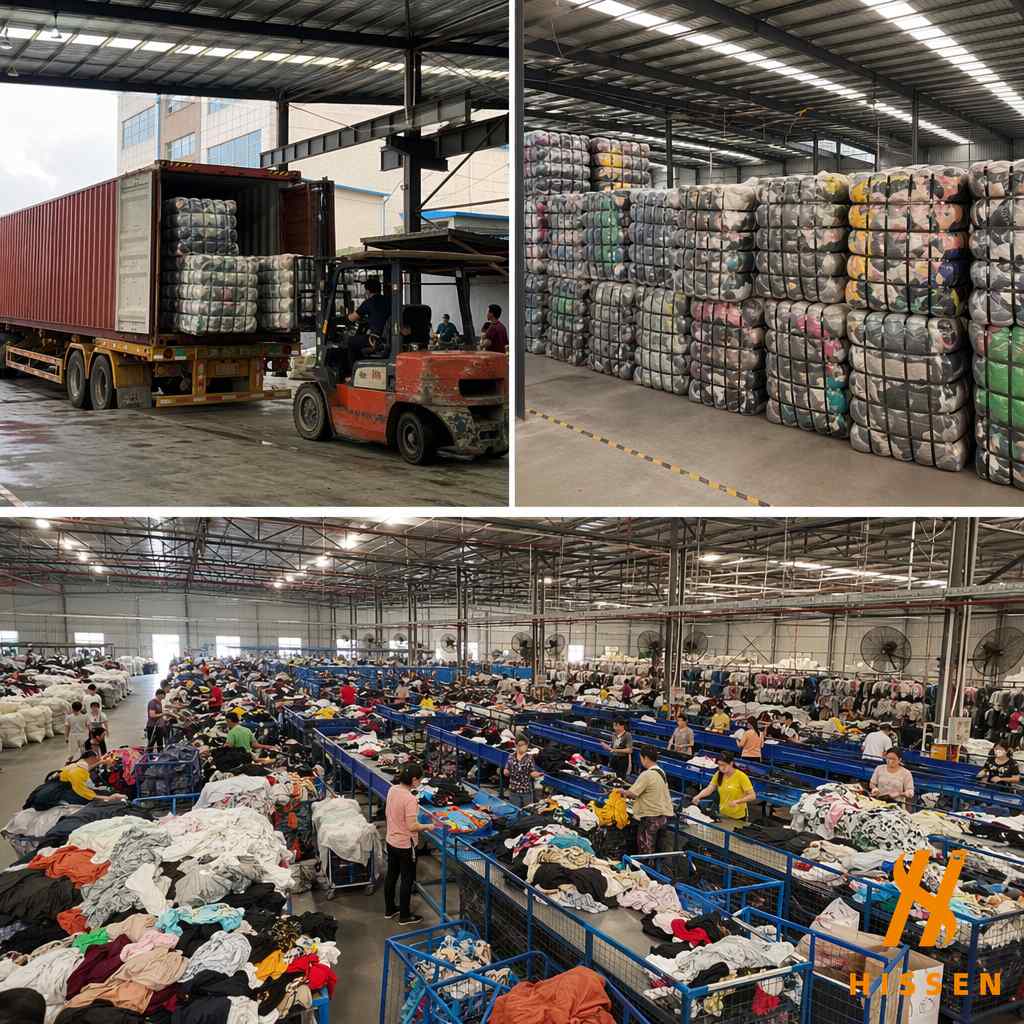
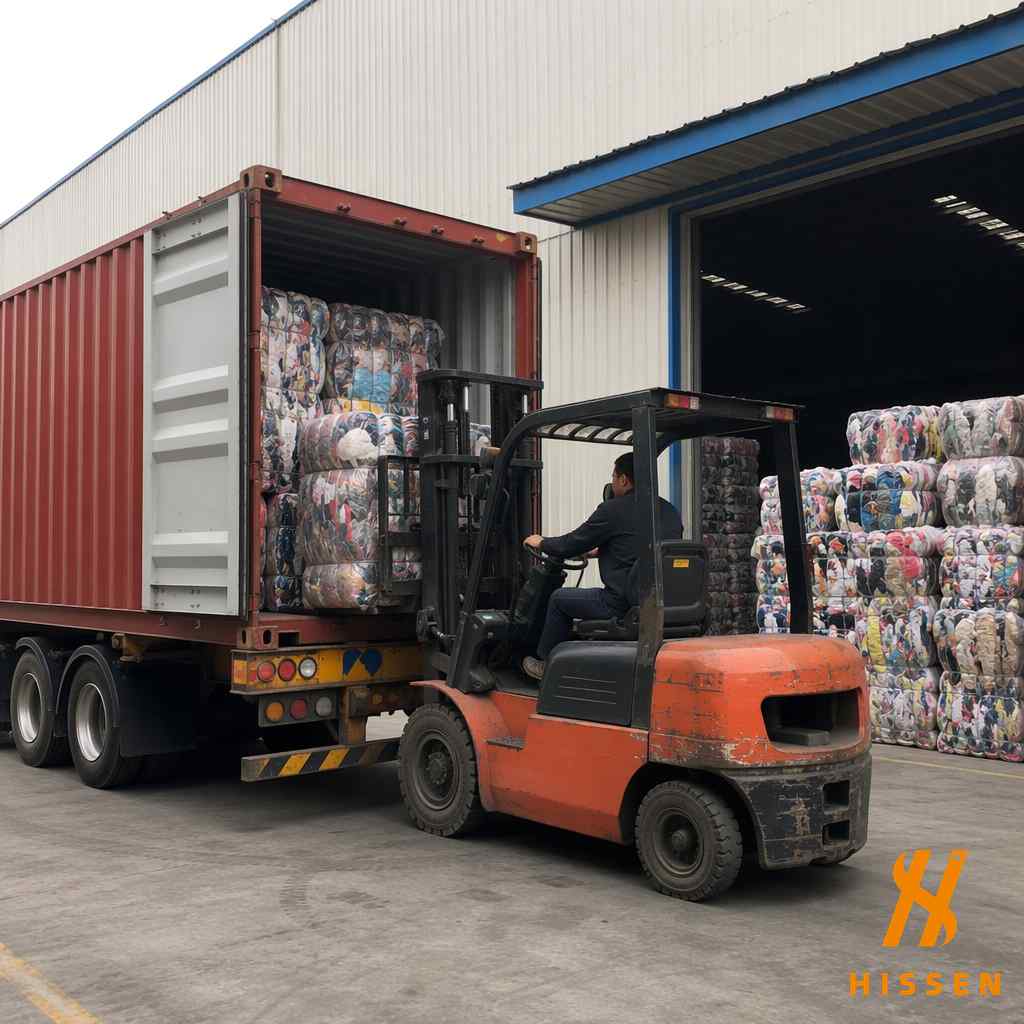
At Hissen Global, we operate our own sorting facility in Guangzhou — which means when you receive a price quote from us, you are getting genuine factory-direct pricing with full transparency.
- 🏭 Own Sorting Facility — We sort, grade, and bale our products in our own facility. No middlemen, no trading company markups.
- 📊 Transparent Cost Breakdown — We explain what goes into our pricing: source material costs, labor, materials, and logistics. You know exactly what you are paying for.
- 📸 Live Video Verification — See our facility, our inventory, and our loading process in real time before you order.
- 📦 Consistent Monthly Volume — We export consistently, serving importers across South America, Africa, and Asia with reliable supply.
- 💬 Market-Specific Knowledge — Our team understands the regulatory and market requirements for importing used clothing into your country.
- 🤝 Volume Pricing for Partners — Importers who commit to regular shipments receive our best factory-direct pricing.
💡 Key Takeaways
- Factory-direct container pricing eliminates middlemen markups of 15-40% — the savings directly impact your bottom line
- Genuine factory-direct exporters own their sorting facilities and offer video verification — if they cannot show you their facility, they are not factory-direct
- Use the 5-step framework: ask about ownership, request cost breakdown, compare against benchmarks, check export volume, start with a pilot
- Factory-direct Grade A mixed bales: $2.50–$3.50/kg FOB — pricing above this range includes intermediary margins
- A pilot container order is essential before negotiating volume pricing
- Hissen Global offers genuine factory-direct pricing with own sorting facility, transparent cost breakdown, and live verification
Frequently Asked Questions
1. What is the difference between factory-direct and trading company pricing for secondhand apparel?
Factory-direct pricing comes from companies that own their sorting facilities and export directly, removing intermediary margins of 10-40%. Trading companies source from multiple factories and add their own markup. Factory-direct pricing is typically 15-30% lower than trading company pricing for equivalent quality.
2. How do I know if a wholesale secondhand apparel company is truly factory-direct?
Ask for a live video tour of their sorting facility, request documentation of facility ownership or lease, and check their export volume consistency. A genuine factory-direct exporter will welcome verification. If a supplier becomes evasive or makes excuses when asked for a facility tour, they are likely a trading company.
3. What is the minimum order for factory-direct container pricing?
Most factory-direct wholesale secondhand apparel companies require a minimum of 1 x 40HQ container for their best pricing. Some offer 20FT containers for new clients, though per-kg pricing is typically 5-10% higher for smaller orders. Volume discounts usually apply at 5+ containers per month.
4. How much does a 40HQ container of factory-direct Grade A used clothing cost in 2026?
A 40HQ container of factory-direct Grade A mixed used clothing from China typically costs $30,000–$52,000 FOB, depending on category mix, seasonal sorting, and bale composition. This is significantly lower than trading company quotes, which range from $38,000–$65,000 for equivalent products.
5. Can I negotiate factory-direct pricing for regular volume orders?
Yes. Most factory-direct exporters offer volume-based pricing tiers. Importers committing to 5+ containers per month typically receive 5-15% discounts. The key is to demonstrate reliability as a buyer — factory-direct exporters value long-term partnerships and will offer their best pricing to retain consistent buyers.
Get Factory-Direct Pricing for Your Next Container
Understanding and accessing factory-direct container pricing is the key to building a profitable used clothing import business. By using the framework in this guide, you can confidently evaluate suppliers, verify their claims, and negotiate pricing that reflects the true value of direct sourcing.
At Hissen Global, factory-direct is not a marketing term — it is how we operate. We invite you to compare our pricing, tour our facility, and experience the difference of working with a genuine factory-direct wholesale secondhand apparel company.
📦 Ready to experience true factory-direct container pricing? We invite you to compare before you decide.
Hissen Global is a China-based factory-direct exporter of Grade A and Grade B used clothing bales for importers in Africa, South America, and Asia. With our own sorting facility in Guangzhou, transparent pricing, and verified quality, we offer the factory-direct advantage to every buyer.
📞 Request Factory-Direct Pricing & Live Video Tour →
✅ Prefer to learn more first? Browse our industry guides for free insights on used clothing importing and supplier evaluation.