Ninety search phrases sit behind the wholesale dress suppliers query, and not one of them contains the words used, second-hand, bale or surplus. The set is entirely new-goods formalwear: prom dresses, evening gowns, cocktail dresses, quinceañera and communion dresses, formal dress manufacturers, dress material suppliers, dropship dress suppliers, and a heavy Thai and Chinese OEM tail. There is no second-hand dress cluster here at all.
That does not make the page impossible to write, but it does decide its shape. This site exports sorted second-hand clothing from China by the kilo. So the first two sections are about who is actually behind these searches and why most of them are on the wrong page. Everything after that is the honest version of the subject for a buyer of sorted stock: a dress bale is the only apparel category where your customers’ dress code grades the bale before the garment’s condition does, and almost nobody specifies it.
Ninety Words, and Only a Fraction of Them Belong Here
Split the cluster by what the buyer is trying to buy:
- New-goods formalwear, roughly 45% of the volume. Prom dress suppliers, prom dress manufacturers, evening gown wholesale manufacturers, cocktail dress wholesale suppliers, quinceañera dress factory, wholesale communion dresses suppliers, formal dress manufacturers, best prom dress companies. These are made-to-order factory buyers. They need a tech pack, a size curve, a minimum per colour and a production calendar. Nothing on a sorting line can serve them.
- Bangkok and Thailand OEM, about 10%. Bangkok dress supplier, supplier dress bangkok, thailand dress supplier, thailand dress maker, dress supplier from bangkok. Factory queries pointed at a contract-manufacturing city. Dealt with in the next section.
- Fabric, not garments. Dress material suppliers wants cloth by the metre from a mill. This site sells finished garments by weight. That is a different supply chain with a different unit of sale.
- Dropshipping and retail. Dropship dress suppliers, where to buy modest dresses online. Single-unit fulfilment and consumer shopping respectively.
- Generic wholesale, roughly 35%. Wholesale skirts suppliers, wholesaler dresses, dress wholesale vendors, dress distributor, dresses supplier, dress wholesaler, ladies dress suppliers. These are the only queries where a sorted-stock exporter can be the right answer, and even here most buyers mean new goods. The unit test in the next paragraph is how you tell.
If you are sourcing prom, evening, bridal or occasion dresses for a shop, this page is not for you. Those are new-goods factory products with a per-style minimum, a size curve and a production lead time. You need a manufacturer and a tech pack, not an exporter selling used clothing by weight. The occasion section below explains why that product behaves differently in this trade, which is worth knowing — but it will not tell you where to place a 300-piece prom order.
The test that separates the two chains takes one line, because the two sides quote in different units. Per piece, per colour, with a size curve and a 300-piece minimum: that is a factory. Per kilogram, in a bale, with a mixed size run: that is a sorting house. A supplier who answers both ways is a trader who will not tell you which side he is on until the invoice.
Bangkok Is a Factory City, Not a Sorting City
The assigned phrase for this page is bangkok dress supplier, and it is worth being direct about why that is a mismatch rather than dancing around it.
Thailand’s garment sector is a contract-manufacturing and OEM base. Thailand dress maker and thailand dress makers are people looking for a workshop that will cut and sew a design to their specification. That industry exists and it is good at what it does. It is simply not the industry that produces sorted second-hand clothing bales, and Thailand is not a sorting origin in this trade — the sorting origins are China, Korea, Japan, the UK, Europe and North America, and the reason is where donated clothing is collected in volume, not where sewing capacity is cheapest.
So if Bangkok is genuinely where you want to buy, what you need is not a supplier directory. You need a specification sheet, a factory audit and a per-style minimum, because a contract workshop cannot quote you anything until you have told it what to make. That is a design-led purchase, and it belongs to a different guide.
What this page can do for the query is the reverse half. Most wholesale dress suppliers you will meet online are one of three things: a factory agent quoting new goods per style, a dropshipper quoting single units, or a sorting house quoting bales by the kilo. Only the third sells used stock, and the giveaway is the price unit. Ask what the minimum is before you ask the price, and the answer tells you which of the three you are talking to.
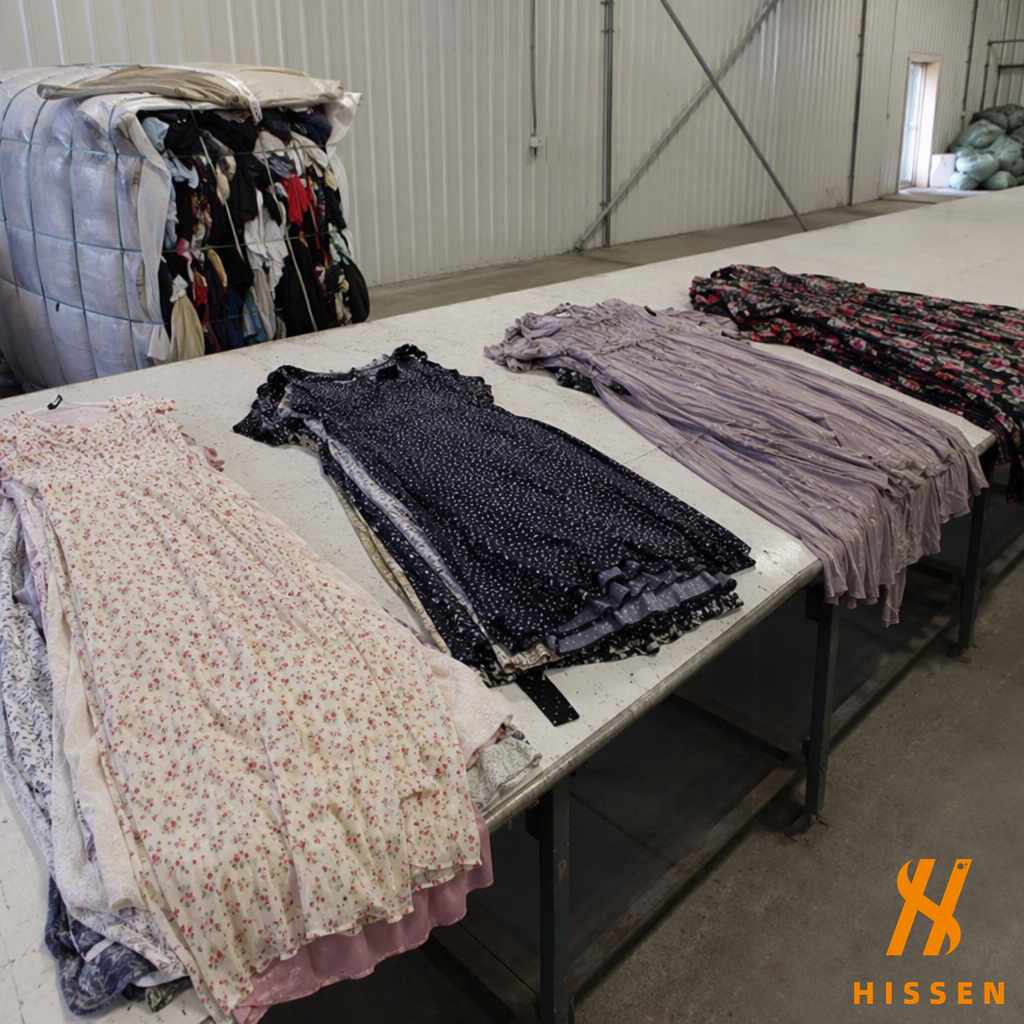
Dress Is Four Products, and the Bale You Are Quoted Is One of Them
A “dress bale” is not a homogeneous product. In a sorted ladies’ bale it separates into four groups with completely different weight, value and risk profiles, and the mix is the first thing to establish:
| Sub-category | Share of a dress bale | Average kg | Pieces in 45 kg | Sellable rate | Cost per sellable piece at $2.20/kg | Typical resale |
|---|---|---|---|---|---|---|
| Day / summer dress | 45–55% | 0.25 | 180 | 78% | $0.71 | $3–7 |
| Long / modest dress | 15–20% | 0.38 | 118 | 75% | $1.13 | $4–9 |
| Occasion / cocktail | 8–12% | 0.45 | 100 | 85% | $1.16 | $10–35 |
| Skirt | 10–15% if mixed | 0.22 | 204 | 80% | $0.61 | $2–5 |
| Mixed adult clothing (comparison) | — | 0.35 | 128 | 66% | $1.16 | $3–8 |
The numbers are a model built at $2.20 per kilogram, not a quotation, and the sellable rates are for a Western European or North American destination. Three things fall out of that table that are not obvious from a price list, and that no wholesale dress suppliers quote sheet will show you.
The margin is in occasion, the volume is in day dress, and the risk is in long. An occasion dress costs almost the same per sellable piece as a long dress but resells for three to four times as much, and its sellable rate is the highest in the table because an occasion dress is the least-worn garment in anyone’s wardrobe — it went to one wedding and came back. That is exactly why occasion stock is sorted out and sold as a pull list rather than left in a bale: the sorting house knows the arithmetic too.
Long and modest dresses carry the category’s real spec risk, for a reason that has nothing to do with wear. Their dominant failure in a destination where modesty is a purchase criterion is opacity, and opacity cannot be judged under warehouse lighting. In a modest-market destination the 75% sellable rate in that row is optimistic; 45% is closer to what an unsorted long-length mix yields when unlined lightweight viscose is in it.
Skirts are the cheapest thing in the bale in both directions. Lowest cost per sellable piece and lowest resale. They are not a margin product; they are a volume filler, and they are forgiving in a way dresses are not, which the last section covers.
Length Is a Spec, and It Is Measured in Centimetres
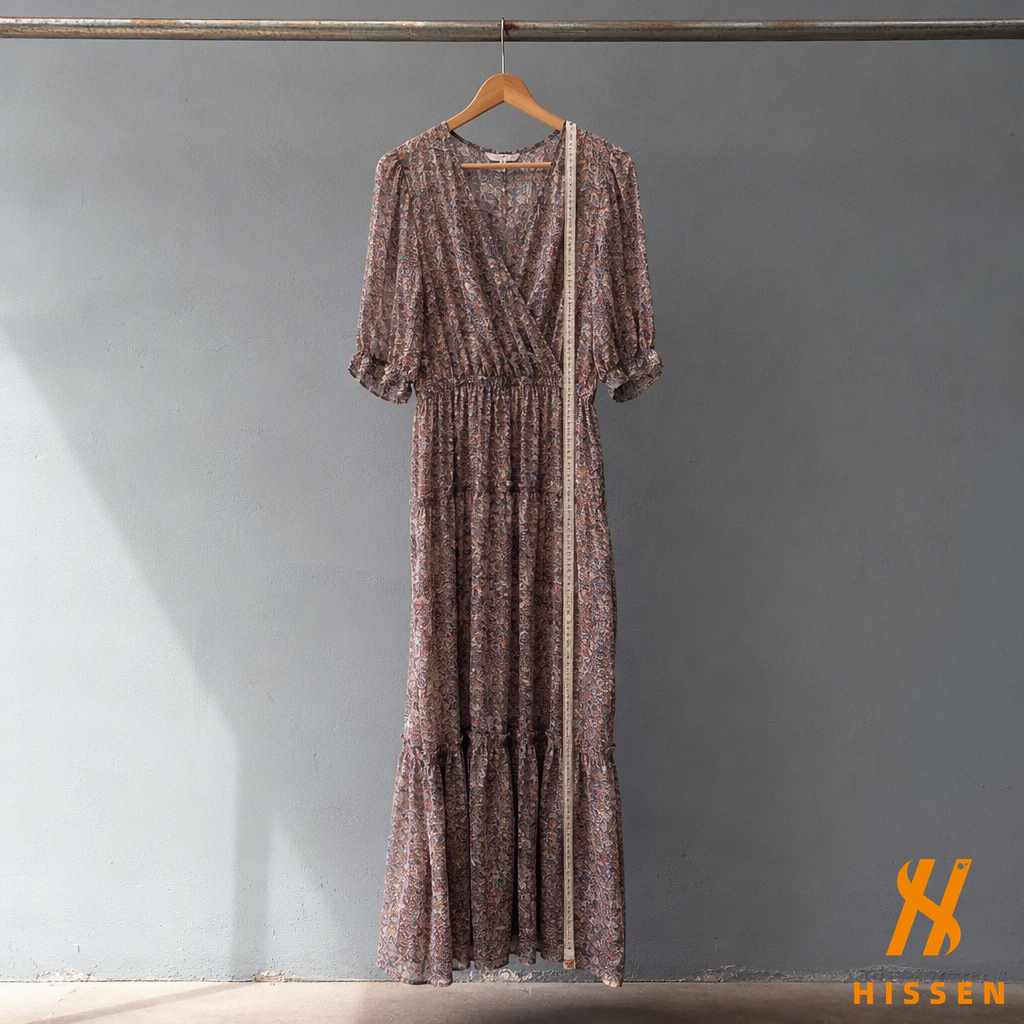
Dresses are the only apparel category where the single highest-yield specification is a length. Not a size, not a grade — a measurement.
The reason is that length decides which market a dress can be sold into, and the sorting trade does not sort on it. A sorting line sorts by fabric weight, by construction and by broad occasion. “Maxi” and “midi” and “knee” are not a length distribution, they are three bins, and a bin spanning 120 to 145 centimetres contains garments that belong in different markets. Two buyers in different countries will grade the identical bale differently for this reason alone: a knee-length sleeveless dress is a strong seller in Jakarta and a slow mover in Kano, and floor-length is the reverse.
So write the specification as shoulder to hem, in centimetres, with a distribution — for example 30 percent at 95 to 115, 40 percent at 115 to 135, 30 percent above 135. A sorting house that grades dresses can produce that from a bale because someone has to hold each garment. A reseller cannot, because nobody has. That distinction is the same one that separates a real outerwear supplier from a trader, and it applies to every specification in this article.
The secondary length specification is the one nobody thinks to ask for: how much of the long-length sort is designed long rather than a petite dress that happens to hang low. A dress cut for a tall frame at ankle length and a dress cut for a short frame with a dropped hem both measure 135 centimetres on a tape, and only one of them fits.
Opacity Is the Spec Nobody Writes Down
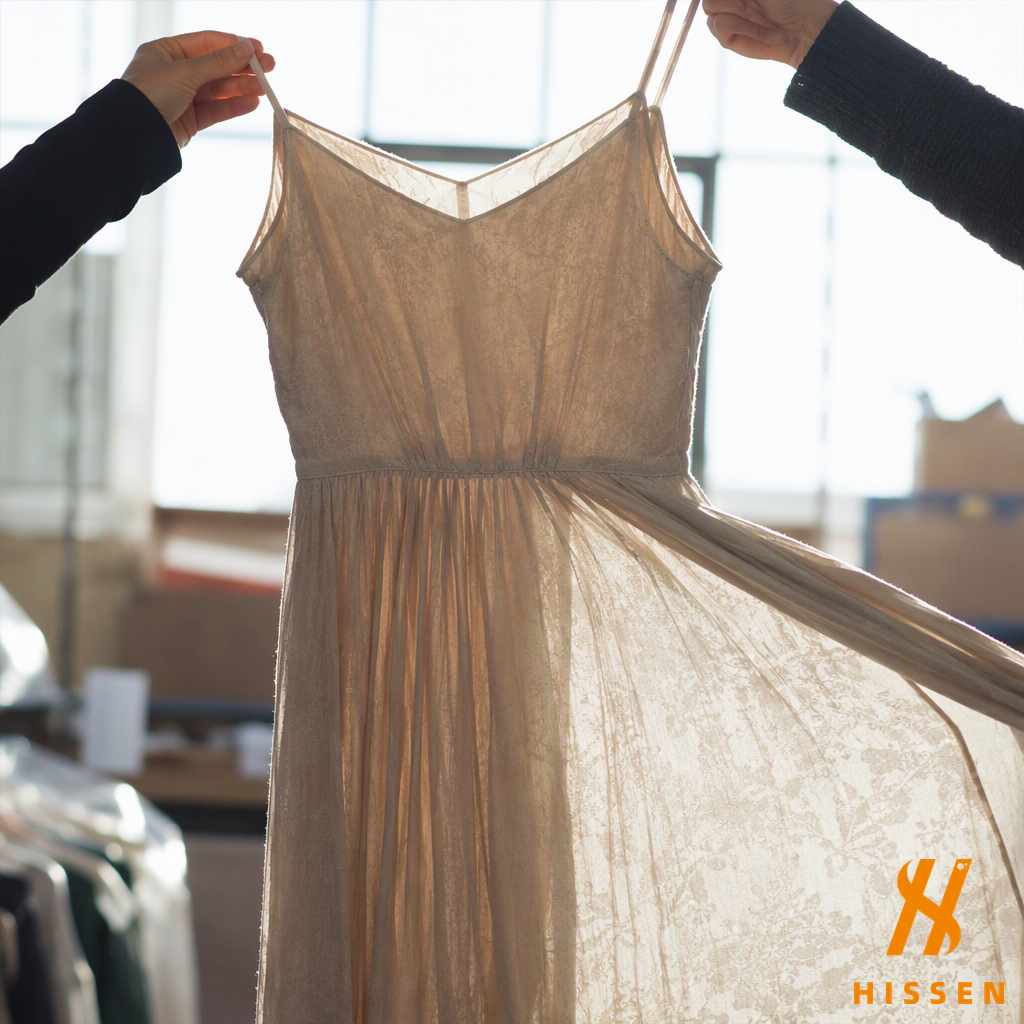
In a large part of this site’s actual market — West Africa, the Horn, East Africa, the Gulf, South Asia, and much of Southeast Asia — the buyer of a long dress is buying for modesty. That turns fabric opacity from a quality detail into a purchase criterion, and it is the most expensive thing a sorting house can get wrong without noticing.
Sheer fabric looks perfectly fine in a bale. It looks fine on a rail under warehouse lighting, because backlighting is what makes a light viscose or a thin polyester crepe sheer and a warehouse does not have a window behind the rail. It reads fine in a photograph. And then it reaches the shop and the customer holds it up against daylight, and a garment that passed every check in China is unsellable.
Three practical consequences follow.
- Lining matters more than fabric weight. A lined light dress is opaque; an unlined one of the same cloth is not. “Fully lined” is a specification you can put in an order and a sorter can verify by turning the garment inside out, which is why it is worth specifying rather than assuming.
- The sunlight test is the only test. Hold the garment up against a window or open sky, not against a wall. There is no substitute, and it cannot be done from a photograph or over a video call.
- Opacity is a market split, not a quality split. An unlined sheer maxi is a legitimate, sellable product in Lisbon and a write-off in Mogadishu. The same bale grades A in one and D in the other. If a supplier tells you a dress bale is grade A without asking where it is going, the grade is about the sorting house’s bin, not about your market.
Sleeve and neckline belong in the same specification for the same reason. They are the other two variables a destination’s dress code fixes and a sorting line does not measure. A buyer sourcing for a modest market who specifies length and opacity but not sleeve will still receive a bale with a substantial share of sleeveless pieces, and those pieces will sit. None of that can be read off a wholesale dress suppliers catalogue, because a catalogue has no photograph in it that shows sheerness.
A Dress Has No Size Chart
Every other category gives you a number you can argue about. Trousers have waist and inseam. Men’s shirts have collar and chest. A dress has one label — S, M, L, or a numeric size that means something different in every decade and every country — and in used clothing that label is frequently unreliable.
Four reasons, and each one is common enough to plan around:
- There is no standard. A dress has no structural reference point that both a manufacturer and a shopper share. Bust, waist and length vary independently, and a “medium” can be a fitted 12 or a loose 16.
- Vanity sizing moved the labels. A size 12 from the 1990s is a size 8 or 10 today in most Western brands. In a bale sorted from older donated stock, the labels run large relative to what your customer expects.
- Labels get cut out. A cut label is standard in this trade — sometimes for brand reasons, sometimes because the label irritated the original owner. A dress bale always contains unlabelled pieces, and they cannot be size-sorted by the label at all.
- Dresses get altered. This is the one that matters most. A dress is the garment most often taken in at the waist or shortened, and an alteration is invisible on the hanger and terminal for fit. A taken-in dress labelled medium will not go over a medium customer.
The specification that works is a measured one: ask for flat bust (pit to pit, doubled), waist, and shoulder-to-hem in centimetres, for ten pieces from the last bale. Ten pieces is enough to see whether the size run is centred where you need it, and it takes a sorter twenty minutes. Nobody who is reselling someone else’s bale will do it, which makes the request a useful filter in itself.
The Failure Map for Dresses Is at the Top and at the Hem
Dresses fail in places that are specific to how dresses are stored, worn and hung, and the distinction that matters commercially is between a defect that lowers a grade and one that removes the garment from sale.
| Defect | Where and why | Effect on value |
|---|---|---|
| Shoulder and upper-back fade | The top of a dress hanging on a rail takes the light for years. Worst on one shoulder, which is the side facing the window. | Grade. Cosmetic but highly visible when worn. |
| Underarm discolouration | Deodorant and antiperspirant residue, set by washing. Almost universal on sleeveless and short-sleeve dresses. | Grade. Permanent, and it cannot be washed out at this age. |
| Hem drag and underarm lining failure | Long hems drag on the ground and on stairs; linings fail where the arm rubs. Both concentrate in the long-length sort. | Grade, and repairable. Worth specifying rather than rejecting. |
| Missing belt or sash | Belts leave dresses in sorting and laundering. A belted dress without its belt reads as a defect to a shopper even though the dress is intact. | Grade. Cheap to specify, easy for a sorter to count. |
| Altered waist or shortened hem | The single most common structural failure in the category, and invisible on a hanger. | Terminal for fit. Exclusion criterion, not a grade. |
| Sheer where it should be opaque | Unlined lightweight viscose and thin crepe. Cannot be seen under warehouse light. | Terminal in a modest destination, irrelevant in a Western one. |
Read that table as two columns of consequence. Fade, underarm marks, hem drag, lining failure and a missing belt are all things that cost you a grade — they reduce what the garment sells for but the garment still sells. An altered waist and a sheer long dress are things that remove the garment from your market entirely, and no discount compensates, because the customer who would have bought it does not exist.
That is the practical rule for a dress order: negotiate on the gradeable defects and make the terminal ones exclusions. An exclusion list costs a sorter almost nothing — they are already removing those pieces — and it removes most of the downside risk in the bale.
Occasion Wear Has a Calendar, and It Is Not Necessarily Yours
The occasion group in the table is the highest-margin thing in a dress bale and the most dangerous to hold, and both facts come from the same property: an occasion dress is bought for a date.
Wedding season, prom season, the Christmas and New Year party window, Eid, Diwali, Chinese New Year, and the graduation cycles all have fixed dates. A dress bought for one of those windows sells at full price in the weeks before it and at a fraction after. Unlike a day dress, which can wait a season, an occasion dress that arrives two months late is not late — it is early for next year, and you have paid storage on it for twelve months.
This is why occasion stock is the clearest example in this trade of a product that leaves the bale before you can buy it. A sorting house with a customer for cocktail dresses sells them as a sorted pull list at several times the bale price, and what remains in the bale is what that customer did not want. If occasion is the reason you are buying, buy a sorted occasion lot and accept the price. Buying a general dress bale hoping for occasion is buying the remainder.
The exception is worth knowing about. In markets where formal dressing is a routine social obligation rather than an occasional one — many West African and South Asian cities, where a wedding invitation is a weekly event rather than a yearly one — occasion stock behaves like daywear and the calendar risk largely disappears. That is one of the few genuine structural reasons to import occasion wear into those markets specifically, and it is a different business from importing it into Europe.
Skirts Are the Exception That Makes the Bale Work
Skirts deserve the separate paragraph that the phrase wholesale skirts suppliers — the largest single query in this cluster, and its lowest difficulty — suggests they never get.
A skirt is the most forgiving garment in the category on every axis that matters. It is the lightest thing in the bale at around 220 grams, so you get 204 pieces in 45 kilograms. Its failure modes are almost entirely repairable: a hem, a waistband button, a split seam, a broken zip on a side opening. And critically, a skirt is size-tolerant in a way a dress is not, because a large share of the category has an elasticated or drawstring waist and a waistband that will move two sizes. That means the size-run problem that defines dresses barely applies.
What skirts are not is a margin product. At roughly $0.61 per sellable piece against a $2 to $5 resale, the arithmetic is thin — the money is in volume and in the fact that they turn over quickly. Skirts are the piece that fills a shop and keeps customers coming back between dress purchases, and they belong in a container as balance rather than as a destination category.
One note on the query itself. Most searches for wholesale skirts suppliers are new-goods searches aimed at a factory, in the same way the dress queries are. The unit test applies unchanged: per piece with a colour minimum is a factory, per kilo in a bale is a sorting house.
What to Put in the Order, and Five Questions
A dress bale is bought on specification or not at all, because almost every specification that matters here is one a sorting line can observe and a reseller cannot. The written order should carry:
- Length distribution in centimetres from shoulder to hem, not the words maxi, midi and knee.
- Lining rate on the long-length sort, as a percentage, because lining is what makes opacity verifiable.
- Sleeve and neckline spread on the long-length sort, stated as counts.
- Measured size run: flat bust, waist and length for ten pieces, plus the share of pieces without a legible label.
- Belt and sash count in pieces, not as a percentage.
- Exclusions: no altered waists, no shortened hems, no unlined sheer garments in the long-length sort, no shoulder-faded pieces in the top grade.
Then five questions, ordered so that the first one already tells you whether the wholesale dress suppliers you are speaking to run a sorting line or a forwarding desk:
- What is the length distribution in centimetres? If the answer is “maxi and midi”, the sort was done by eye and there is no specification to buy.
- What share of the long-length sort is lined? This is the opacity question in a form a sorter can answer with a number.
- Give me measured bust, waist and length for ten pieces, and tell me how many pieces have no label. A sorter can do it in twenty minutes. A reseller will change the subject.
- How many belts and sashes are still with their dresses? A surprising number of suppliers discover at this point that they have never counted.
- Where do your occasion dresses go? The answer tells you what has already been pulled out of the bale before you got it.
There is also an arithmetic check that catches most confused dress offers. A 45 kilogram bale quoted at 120 pieces implies 375 grams per garment on average. That is occasion-dress or heavy-jersey weight, not a summer dress bale, which should run nearer 180 pieces. If the piece count and the description do not reconcile, one of them is a template. The general weight reference on How Much Is a KG of Clothes? gives the bands to check against, and the order sequence itself — unit, minimum, inspection, claims — is set out on Second Hand & Vintage Clothing: Bulk Prices & How to Order and applies unchanged here.
Where Dresses Sit in a Container
Dresses are the best freight proposition in women’s clothing, and of everything the wholesale dress suppliers in this trade carry they are the cheapest thing to move per sellable unit. At 250 to 450 grams they sit behind only t-shirts and blouses on pieces per tonne, so a container filled with them carries more sellable units per dollar of freight than one filled with anything heavier. That makes the dress bale the natural volume base of a summer container rather than an add-on to it.
The counterweight is value density. Dresses are cheap per piece, which means the revenue per container is low relative to a denim or outerwear load, and the margin has to come from turnover rather than from price. The structure that works for most importers is a container built on dresses, skirts and summer blouses for volume, with a small number of higher-value sorted lots — occasion dresses, if the calendar and the market suit — carried inside it.
How a women’s summer bale is composed, graded and priced is covered on Bulk Second Hand Summer Clothes for Women Wholesale and, for the premium end of the same product, on Premium Grade Summer Mix Used Clothing Bales Supplier. Where dresses rank against the other categories on profitability is on Used Clothing Categories Ranked, which places Ladies Dresses & Skirts fifth of eight on year-round demand. Bale formats themselves are on Bales of Clothes, and the grade vocabulary used across the trade is on Used Wholesale Clothing.
Frequently Asked Questions
How many dresses are in a 45 kg bale?
Between about 100 and 204, depending entirely on the sub-category. A summer dress bale runs near 180 pieces, a long and modest dress bale about 118, an occasion dress bale about 100, and a skirt bale about 204. A supplier who quotes one number for a dress bale without asking which kind of dress is quoting a template.
What does a used dress bale cost per kilogram?
A sorted ladies’ dress bale sits in the middle of the range for single-category sorts, above mixed summer and below branded or occasion-only lots. The figure to compare is cost per sellable piece, which at $2.20 per kilogram runs from about $0.61 for skirts to around $1.16 for occasion dresses — and it is the resale band, not the cost, that separates them.
Can I buy wholesale dress suppliers’ stock in a modest cut?
Only by specifying it. Standard European and North American sorted stock is not built for modest dress codes, because the source wardrobes were not. Length, lining and sleeve have to be written into the order as measurable specifications, and the long-length sort has to be checked for opacity against daylight rather than warehouse lighting.
Why is the bangkok dress supplier phrase on this page?
Because it is a factory query, and this page is the honest answer rather than the convenient one. Bangkok is a contract-manufacturing centre for new garments; it is not a sorting origin for second-hand clothing. If you need new dresses made to your design, you need a workshop, a tech pack and a per-style minimum. If you are buying sorted stock by the kilo, the origins are China, Korea, Japan, the UK and Europe.
Are occasion dresses worth buying in bulk?
Yes, if you buy them as a sorted lot rather than hoping to find them in a general bale. Occasion wear has the highest sellable rate and the highest resale in the category, so it is the first thing a sorting house removes for its own customers. Buying a dress bale for the occasion content means buying what those customers rejected.
How do I check the size run of a dress bale?
Do not use the labels. Ask for flat bust, waist and shoulder-to-hem measurements in centimetres for ten pieces, plus the share of pieces with no legible label. Dresses have no structural standard, labels were vanity-sized across the decades, and a meaningful share of any dress bale has been altered at the waist.
What is the most common defect in a used dress bale?
Underarm discolouration on sleeveless and short-sleeve pieces, and shoulder fade on the top of the rail. Both are cosmetic and both reduce the grade. The defects that remove a garment from sale rather than reducing its price are altered waists, shortened hems, and sheer fabric in a market where a long dress is bought for modesty.
Are skirts a good product to import?
As volume, yes. A skirt is light, its defects are mostly repairable, and its waistbands tolerate size variation far better than a dress does. As a margin product it is thin — roughly $0.61 per sellable piece against a $2 to $5 resale. Skirts balance a container; they do not carry one.