Published September 16, 2026 · Kenya import guide for kitchenware buyers
How to Import Wholesale Kitchenware From China to Kenya in 2026: PVoC, Duties & Mombasa Guide
Kenya is arguably the most accessible large kitchenware market in East Africa. There is no prohibition on kitchenware, a mature wholesale trade already imports Chinese cookware at scale, and household demand for pots and pans is steady and growing. That is the good news.
The challenge is different from most African markets: in Kenya, the gate is not a ban — it is conformity certification. A container without the right certificate does not get refused at the border; it gets sent for destination inspection, and the delay and penalties eat your margin. From our position as a China-based exporter of stock kitchenware sold by the kilogram, this guide walks you through importing kitchenware from China to Kenya in 2026: the PVoC requirement, food-contact testing, the duty stack that lifts landed cost to roughly half of CIF, and where your container actually lands.
⏱ 12 min read · For importers & wholesalers shipping kitchenware to Kenya
In this guide you will learn:
- Why kitchenware is permitted in Kenya — and why permission is not the real hurdle
- The 2026 PVoC changes: new agencies, new deadlines, and what happens without a CoC
- Food contact materials testing under KS 1515 and heavy metal migration limits
- Why landed cost reaches about 50% of CIF — the full duty and levy stack
- The sub-category decision that protects your margin
- Mombasa vs ICD Embakasi — where Kenyan kitchenware containers actually go
- The Advance Cargo Declaration that importers forget
- An 8-step process for your first container
✅ Is Kitchenware Allowed Into Kenya? Yes — Clearance Is the Real Hurdle
Unlike several markets in the region, Kenya does not prohibit kitchenware imports. Stock cookware, utensils, cutlery, and tableware can all be imported commercially. There is also no import licensing regime standing between you and the goods, and China already supplies the largest share of Kenya’s kitchenware imports.
What Kenya does have is a strict pre-shipment conformity regime. The distinction matters strategically: your risk in Kenya is not “will the goods be confiscated” but “will the documentation be accepted”. That is a solvable, plannable problem — but only if you start before the container sails.
| Question | Answer for Kenya (2026) |
|---|---|
| Is kitchenware prohibited? | ✅ No — kitchenware is importable |
| Is an import licence required? | No specific licence for kitchenware; the importer must be registered and hold an IDF |
| Is pre-shipment certification required? | ✅ Yes — a Certificate of Conformity (CoC) under KEBS PVoC |
| Can certification be completed at the port? | Effectively no — goods without a CoC go to destination inspection with penalties and delay |
🔬 The 2026 PVoC Gate: Certificate of Conformity or Destination Inspection
Kenya’s PVoC (Pre-Export Verification of Conformity) programme, run by the Kenya Bureau of Standards (KEBS), requires regulated products to be verified in the country of export — China — before shipment. Verification results in a Certificate of Conformity (CoC), which is the document customs needs at the port.
2026 brought significant changes that every Chinese exporter to Kenya should know:
- 📅 KEBS’ previous PVoC contracts expired on 8 February 2026. New three-year contracts (2026–2029) took effect, involving nine newly contracted inspection bodies.
- 🔄 From 1 March 2026, goods from designated countries including China must carry a CoC issued by a newly authorised agency. Widely used bodies include Intertek, Cotecna, SGS, BV, TÜV Rheinland and CCIC. Cotecna is authorised for Zone 1 — mainland China, Taiwan, Hong Kong and Mongolia.
- 📘 The KEBS PVoC Operations Manual was upgraded to Version 15 (issued 19 February 2026), replacing Version 14.
- ⏱ Applications submitted before 8 February 2026 had to complete issuance by 28 February 2026, or be re-applied for. Certification fees rose modestly.
- 🧪 Some daily-use plastics, stationery and low-voltage electrical items were added to priority supervision, and chemical-limit testing was added for certain categories.
⚠️ What happens without a CoC: goods are not simply turned away — they are routed to destination inspection and charged an inspection fee of up to 5% of the customs-assessed value (under Legal Notice No. 78 of 2020), plus laboratory testing costs if testing is required. Add the days lost, and the true cost runs well beyond the fee itself.
💡 Practical timing: start the PVoC process at least one month before shipment. Document review, possible testing, and pre-shipment verification at the factory all take working days — and the most common failure is starting too late.
📋 Documents you will need: application form, proforma invoice, packing list, product test report, business licence, and the IDF (Import Declaration Form) — which your Kenyan importer must obtain and provide. All documents must be in English.
⚙️ Certification models: Model A (product testing plus registration), Model B (batch/shipment inspection — the most common for kitchenware), and Model C (product certification plus factory audit, best for long-term bulk buyers). CoC issuance typically takes about 5–8 working days and the certificate is generally valid for 90 days. Inspection fees commonly run 0.5%–1.5% of goods value, with testing billed separately.

🧪 Food Contact Materials: KS 1515 and Heavy Metal Migration
Kitchenware sits in a priority category under Kenya’s controlled product list because it touches food. Specifically, food contact materials — tableware, kitchenware, and packaging containers — are explicitly regulated.
The technical focus is whether the material migrates harmful substances into food under normal use. For metal cookware and cutlery, that means heavy metal migration testing, commonly assessed against KS 1515 using methods such as ICP-OES or XRF. Indicative limits referenced in the industry are cadmium at or below 100 ppm and lead at or below 1,000 ppm. Testing covers heavy metals, migration, and microbiological parameters.
| Requirement | What KEBS expects |
|---|---|
| Laboratory | ISO/IEC 17025-accredited lab with CNAS or ILAC-MRA mark |
| Report content | Product name, brand, HS code, manufacturer, batch, material, standard number, test data and conclusion |
| Language | English |
| Report validity | High-risk products: within 3 months. Ordinary products: within 12 months. Expired reports are rejected with no grace period |
| Consistency | Model, brand and HS code must match the invoice, packing list, labels and the physical goods exactly |
| Not accepted | CE or RoHS reports are not accepted as substitutes |
⚡ Why this matters commercially, not just legally: the metal grade of your cookware is now a certification issue, not only a cost decision. Lower-grade steel that fails migration testing can stop an entire container. When you compare suppliers, ask what grade they stock and whether their goods already carry recognised test reports — that single question separates suppliers who understand Kenya from those who do not.
For the full picture of how weight-based buying works, see our guide to wholesale kitchenware by kg from China, and for the cost side see our kitchenware price per kg breakdown.
💰 Duty and Levies: Why Landed Cost Reaches About 50% of CIF
Kenya applies the East African Community Common External Tariff, which uses four bands: 0% for raw materials and capital goods, 10% for intermediate goods, 25% for finished goods, and 35% for protected items such as certain textiles, iron and steel, and agricultural products. Finished consumer kitchenware generally falls in the 25% band, though specific steel items may be classified higher.
On top of duty, three charges apply — and note that 2026 rates differ from older guides still circulating online:
| Charge | 2026 rate | Base |
|---|---|---|
| Import duty (EAC CET) | 0% / 10% / 25% / 35% | CIF |
| IDF (Import Declaration Fee) | 2.5% (min KES 5,000) | CIF |
| RDL (Railway Development Levy) | 2% | CIF |
| VAT | 16% | CIF + duty + excise + IDF + RDL |
⚠️ Watch out for stale figures. Many online guides still quote IDF at 3.5% and RDL at 1.5%. Those rates changed — IDF was reduced to 2.5% and RDL increased to 2%. Budgeting from outdated sources is a common and avoidable error.
Here is how it stacks up on an illustrative KES 1,000,000 CIF shipment at the 25% duty band:
| Item | Calculation | Amount (KES) |
|---|---|---|
| Import duty (25%) | 1,000,000 × 25% | 250,000 |
| IDF (2.5%) | 1,000,000 × 2.5% | 25,000 |
| RDL (2%) | 1,000,000 × 2% | 20,000 |
| VAT (16%) | 1,295,000 × 16% | 207,200 |
| Total taxes | ≈ 50.2% of CIF | 502,200 |
📊 Two important notes. First, VAT compounds — it is charged on CIF plus duty, IDF and RDL, not on CIF alone. Second, if your Kenyan buyer is VAT-registered (turnover above KES 5 million), they can reclaim import VAT as input tax, which materially changes the real cost. This is worth raising with buyers — it is a genuine point in favour of buying through a registered importer.
To see how these layers apply to container imports generally, read our breakdown of shipping costs when importing stock goods from China.

⚖️ Ceramic or Stainless Steel? The Sub-Category Decision That Protects Your Margin
We have to be careful and honest here, because this is where misinformation circulates most freely in our industry.
You may encounter claims that Kenya imposes anti-dumping duties of up to 45% on Chinese daily-use ceramics. Those claims come from customs-agent and freight websites. We have not found a published HS code, rate schedule, or gazette reference supporting them — and against them stands the observation, in WTO trade policy review material for the East African Community, that EAC states had not applied trade remedy measures. That review may predate 2026, so it is not conclusive either.
Our conclusion: this claim is neither confirmed nor excluded. Verify before you ship. If you plan to import ceramic tableware (HS 6911/6912), confirm the current position directly with KRA, KEBS, or your clearing agent.
⚠️ Do not confuse ceramic tiles with ceramic tableware
The 2026 EAC tariff changes raised duties on ceramic tiles under HS 6907.21 / 6907.22 / 6907.23 / 6907.30 / 6907.40 — that is flooring and wall tile, not tableware. Ceramic dishes and plates sit under 6911 (porcelain) and 6912 (other ceramic). We have now seen this exact confusion appear in four different markets. Always check whether a “ceramic tariff” headline refers to 6907 or 6911/6912 before drawing any conclusion.
✅ The lower-risk path — and the one we recommend: build your Kenyan load around stainless steel (HS 7323) and aluminium (HS 7615) cookware, with cutlery under 8215 and glassware under 7013. This sidesteps the ceramic question entirely, and it also fits Kenyan demand — urban consumers specifically ask for non-stick cookware (sufuria), and local manufacturing largely supplies only low-priced simple lines for rural markets.
For a market-by-market comparison of where ceramic tableware carries real risk and where it does not, see our guide to importing kitchenware into another major African market — the sub-category logic is the same and worth understanding before you choose your mix.
🚢 Mombasa vs ICD Embakasi: Where Your Container Actually Lands
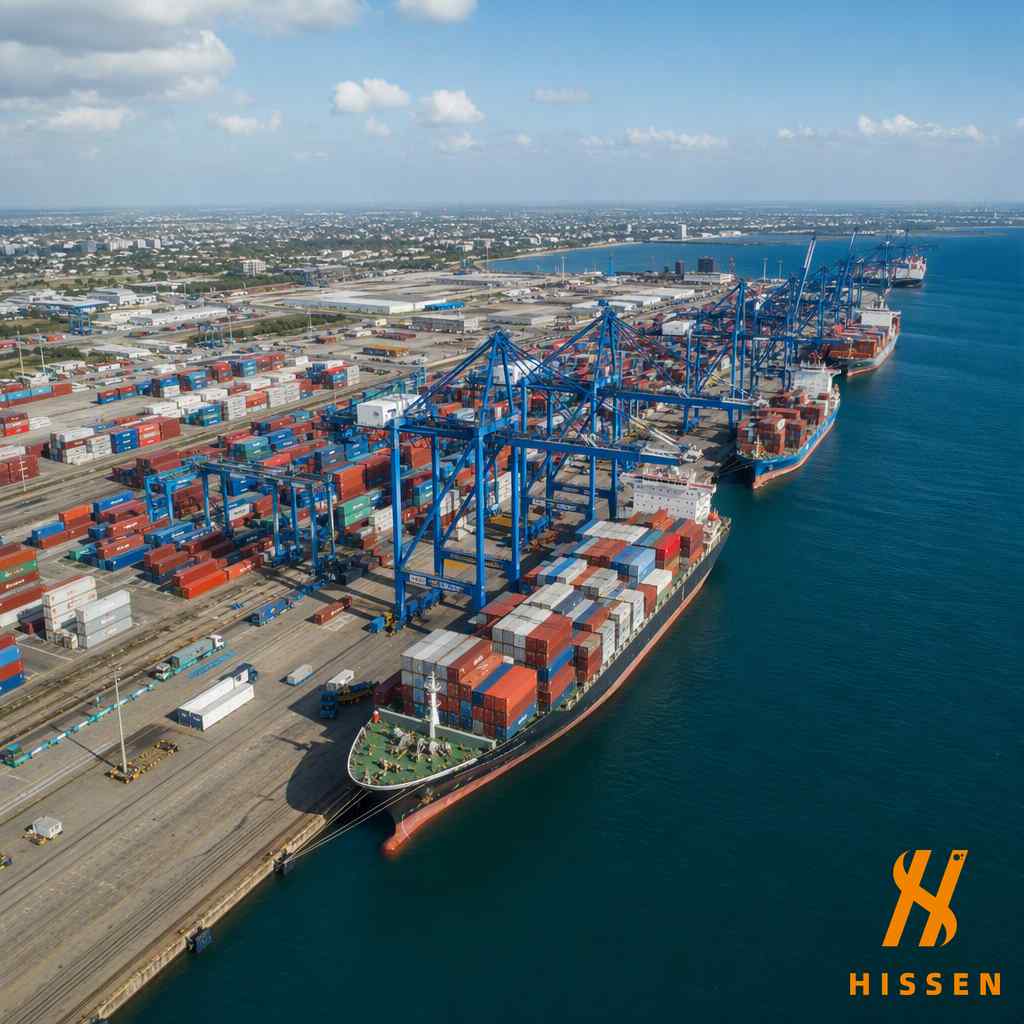
This is one of the most useful practical details about the Kenyan market, and many first-time importers do not know it: most kitchenware imported into Kenya does not clear at the coast. The majority of containers are railed inland and cleared at the inland container depot serving Nairobi.
Industry import records indicate that roughly 74% of these shipments are handled at the ICD Embakasi inland depot, with about 26% cleared at Mombasa. Nairobi is where the wholesale buyers are, so inland clearance is the mainstream route rather than the exception.
- 🚢 Port of Mombasa — Kenya’s maritime gateway; transit from Guangzhou is commonly around 18–25 days.
- 🚂 ICD Embakasi (Nairobi) — the dominant clearance point, connected by rail to Mombasa.
- 🏙️ Nairobi wholesale districts — the commercial heart of Kenyan kitchenware distribution.
💡 What this means for you: confirm with your buyer whether they clear at Mombasa or Embakasi, because it changes their cash-flow timeline and your delivery expectations. It also explains why Nairobi-based wholesalers are the natural customers for container-scale kitchenware importers.

📈 The Kenyan Market: Why Chinese Kitchenware Dominates
Kenya is not a market you have to create demand in — it is a market where demand already exists and supply relationships are established. The numbers explain why:
- 🇨🇳 China supplies the largest share by value of Kenya’s porcelain and ceramic tableware and kitchenware imports — around 61%, with the UAE a distant second at roughly 15%. Globally, China accounts for about two-thirds of porcelain tableware and kitchenware production.
- 📈 The Kenyan kitchenware market has been growing at roughly 14% annually, with growth projected to peak around 15.88% before settling to about 11.17% by 2029.
- 🏬 A mature China-sourcing import trade already exists in Nairobi. Established wholesalers import Chinese kitchenware monthly, and several competitors operate in the same district. This is proof of a working business model — you would be joining a proven trade, not testing an unproven one.
- 🎯 Demand skews to non-stick and modern styles. Urban consumers specifically request non-stick cookware, are price-sensitive, and expect fast turnover of styles. Local production covers mainly simple, low-priced goods for rural markets.
⚡ The strategic implication: because the trade is already established, your competitive edge in Kenya comes from mix and price per kg, not from novelty. A supplier who can shape a load around non-stick cookware and mid-size pots, at a competitive weight-based price, is more useful to a Nairobi wholesaler than one offering a fixed assortment.
📑 The Advance Cargo Declaration: The Separate Document Importers Forget
Since 3 August 2026, Kenya has fully implemented the Advance Cargo Declaration (ACD). The critical point is that the ACD is an independent document — it is not interchangeable with the PVoC Certificate of Conformity. Both are required, and holding one does not satisfy the other.
If your CoC is complete but the ACD is missing, your cargo stalls. Treat them as two separate workstreams with two separate deadlines.
🗺️ Your First Kitchenware Container to Kenya: 8 Steps
- 🔍 Lock the HS code first. Confirm classification for each category — 7323 steel, 7615 aluminium, 8215 cutlery, 7013 glassware, 6911/6912 ceramics — against the EAC CET schedule.
- 🧪 Confirm test reports exist. Check that your supplier’s goods carry reports from an ISO/IEC 17025 lab, and that they are within validity.
- 🏦 Ensure your buyer obtains the IDF. The Kenyan importer must provide this before PVoC application.
- 📋 Apply for PVoC through an authorised 2026 agency. Confirm your agency is on the current KEBS list — for mainland China, Zone 1 is covered by Cotecna.
- 🏭 Complete pre-shipment verification. Inspection happens at the factory or warehouse before loading.
- 📄 Obtain the CoC before arrival. Typically 5–8 working days, valid around 90 days.
- 🗂️ File the Advance Cargo Declaration separately. Independent of the CoC — both are required.
- 📈 Start with one 20-foot container. Measure sell-through by category, then scale to 40-foot loads where the price per kg improves.
🇨🇳 Why Kenyan Importers Compare Hissen Global
We would rather you compare us than simply trust us. Hissen Global is a China-based exporter selling wholesale kitchenware by the kilogram from a 20,000 m² warehouse, with a minimum order of one 20-foot container. Our range covers five categories — cookware, mixed kitchenware, kitchen knives, knives & forks, and kitchen utensils — so you can build a mix matched to Kenyan demand, including the non-stick and mid-size cookware that Nairobi buyers ask for.
Three things matter most for Kenya, and we focus on all three: stainless steel and aluminium cookware that fits the lower-risk certification path rather than the ceramic question mark; weight-accurate packing lists so your IDF, PVoC file and customs assessment agree; and quality screening — no rusted cookware, no missing lids, no cracked items, no loose handles — so certified goods actually sell. Browse our full product range or learn more about our company.
❓ Frequently Asked Questions
Is kitchenware allowed to be imported into Kenya in 2026?
Does kitchenware need PVoC certification for Kenya?
What happens if my kitchenware container arrives in Kenya without a CoC?
How much import duty does kitchenware attract in Kenya?
Is there an anti-dumping duty on Chinese ceramic tableware in Kenya?
Where do kitchenware containers clear customs in Kenya?
💡 Key Takeaways
- Kenya permits kitchenware imports — the real hurdle is the KEBS Certificate of Conformity, which must be obtained before shipment.
- 2026 changed the PVoC landscape: new agencies from 1 March 2026, Operations Manual Version 15, and Cotecna authorised for Zone 1 covering mainland China.
- Without a CoC, goods go to destination inspection at up to 5% of assessed value — plus delay, which costs more than the fee.
- Food contact testing under KS 1515 makes metal grade a certification issue; keep reports current and from an ISO/IEC 17025 lab.
- Budget around 50% of CIF in taxes: 25% duty, 2.5% IDF, 2% RDL and 16% compounding VAT. VAT-registered buyers can reclaim the VAT.
- Stainless steel (7323) and aluminium (7615) sidestep the unresolved ceramic tableware question and match Kenyan non-stick demand.
- About three-quarters of kitchenware containers clear at the ICD Embakasi inland depot near Nairobi, not at Mombasa.
- The Advance Cargo Declaration is separate from the CoC — both are required.
Planning your first kitchenware container to Kenya? We invite you to compare before you decide.
Hissen Global is a China-based exporter selling wholesale kitchenware by kg from a 20,000 m² warehouse — cookware, mixed kitchenware, kitchen knives, knives & forks, and kitchen utensils. Minimum order: one 20-foot container. We supply stainless steel and aluminium cookware suited to Kenya’s certification path, with weight-accurate packing lists for your PVoC file.
📱 WhatsApp: +86 191 2829 4940
Request Pricing & Live Video Tour →
Related: Wholesale Kitchenware by KG — Complete Guide · Kitchenware Price Per KG — Cost Breakdown · Import Kitchenware to Nigeria — Duties & SONCAP · Import Kitchenware to Chile & Colombia — FTA & Duty Guide · Import Kitchenware to Peru & Ecuador — FTA & Duty Guide · Import Kitchenware to Bolivia & Paraguay — Landlocked Routes & IBNORCA · Browse all product categories