Most buyers who search for a Y2K wholesale supplier are asking for something the trade cannot supply in the way they expect. They are asking for a supplier of a style. What actually exists is a supplier of a window — a stretch of years during which the garments of one era are being discarded in enough volume to be collected, sorted and baled.
That window opens and closes on its own schedule. It is not a catalogue you can order from at will, and it does not restock. The 1970s closed long ago. The 1990s is closing now. Y2K is in the middle of its opening, which is why buyers now ask a Y2K wholesale supplier for something that was not a wholesale category five years ago.
This guide is about that mechanism: why a decade behaves like a supply window rather than a product category, why Y2K arrived in bulk when it did, how to verify an era claim on a garment rather than a listing, why three different businesses wear the same name, what a bale actually yields once the era filter is applied, what the price is tracking, and how to write a decade into an order so that a miss is a documented shortfall rather than an argument.
⏱ 14 min read · For vintage and Y2K buyers sourcing at wholesale
In this guide you will learn:
- Why a decade is a supply window, and why it cannot be replenished
- What made Y2K the first era that can be baled in volume
- What Y2K stock actually is — and which pieces of it have already fallen apart
- Four checks that date a garment in about ten seconds
- The three businesses selling under the words “Y2K wholesale”
- Selection-rate arithmetic: why a per-kilo comparison can be wrong by a factor of two
- What Y2K pricing tracks, and the two curves you are trying to time
- How to write an era specification into a purchase order
A Decade Is a Supply Window, Not a Style
Second-hand clothing reaches the sorting house years after it was bought. The lag is the single most useful number in this trade. A garment is purchased, worn for a period that depends on how cheap it was and how fast it went out of fashion, then donated, handed down, put in a collection bank or thrown into a municipal stream. Only at that point does it become bale stock.
The working range is roughly ten to twenty-five years. Cheap fast fashion at the short end — a printed polyester top bought in 2008 and discarded in 2016. Heavier, more expensive or more formal goods at the long end, because people keep a wool coat or a good pair of jeans for a decade before it leaves the wardrobe. Age of garment at discard, plus age of stock at sorting, is what puts an era in front of you.
Two consequences follow, and they decide almost everything about buying by era:
- Supply arrives as a wave, not a level. Each decade’s production enters the stream in a lump as that decade’s purchases reach end of life. There is a rising edge, a thick middle, and a long thin tail.
- Nothing is replenished. No factory will ever make another 1975 shirt for the used stream. Once an era’s wave has passed, the remaining supply is whatever individual owners still hold, and that is a different market entirely — dealers, auctions and piece-by-piece buying, not bales.
This is why a buyer asking for a decade is really asking a supply question. The 1970s wave peaked and passed in the 1990s. By the time anyone wanted 1970s clothing in quantity, the population had already thrown it away. The 1990s is in its tail now. Y2K is thick. A Y2K wholesale supplier cannot open the window and cannot extend it; what they can do is tell you where in the window the current stock sits, which is the only question worth asking them.
If you are new to the vocabulary underneath all of this — what makes a garment vintage at all, how second-hand categories and grades are defined, how the trade prices a mixed load — start with the second hand and vintage clothing guide. It sets out the category and grade structure this page assumes. What follows here is the era layer: how to specify, verify and buy within a decade.
A note if you arrived looking for somewhere to shop
Some of the searches that lead to this page are from people who want to buy one Y2K top or one pair of low-rise jeans for themselves. This page cannot help with that, and no wholesale supplier can. Wholesale here means a bale or a container, sold to a business that resells. For a single piece, the right places are resale platforms, vintage shops and charity retail in your own market — where the stock is the same wave described above, sold one item at a time.
Why Y2K Arrived in Bulk Now
Every era produces clothing. Only some eras produce clothing in quantities that can be baled. Y2K is the first decade where both conditions were true at once: enormous volume, and short enough garment life that the volume reached the waste stream quickly.
The volume is not a matter of taste. The widely cited figure is that global clothing production roughly doubled between 2000 and 2015, while the average number of times a garment was worn before disposal fell. That combination — more made, each worn less — is what created a decade that could be sorted and exported as era stock rather than as anonymous mixed rags.
Two structural changes sit underneath it. The Multi Fibre Arrangement, the quota system that had capped apparel exports from developing countries for decades, expired at the start of 2005, and volumes from Asia grew quickly afterwards. Alongside that, basic garments became cheap enough that repair stopped being rational: a torn seam on a £6 top is a replacement, and that pushes goods into the stream on the fast side of the lag.
So Y2K occupies an unusual position. It has the volume of fast fashion and the date range of vintage. The 1990s has volume but a slower discard profile — those clothes were more expensive relative to income, so they were kept longer and are now arriving thinned and faded. The 1980s has almost no volume left. That is why one era produces bales and the others produce individual pieces.
The window has an implied expiry. The core Y2K production years — call them 1999 to 2005 — are arriving now and should stay available in sorted form for roughly a decade before selection rates fall the way the 1990s’ are falling. Buying into an era is also a bet on how long the window stays open at your price and quality floor, and buying late means competing for a shrinking share of a shrinking wave.
What Counts as Y2K Stock
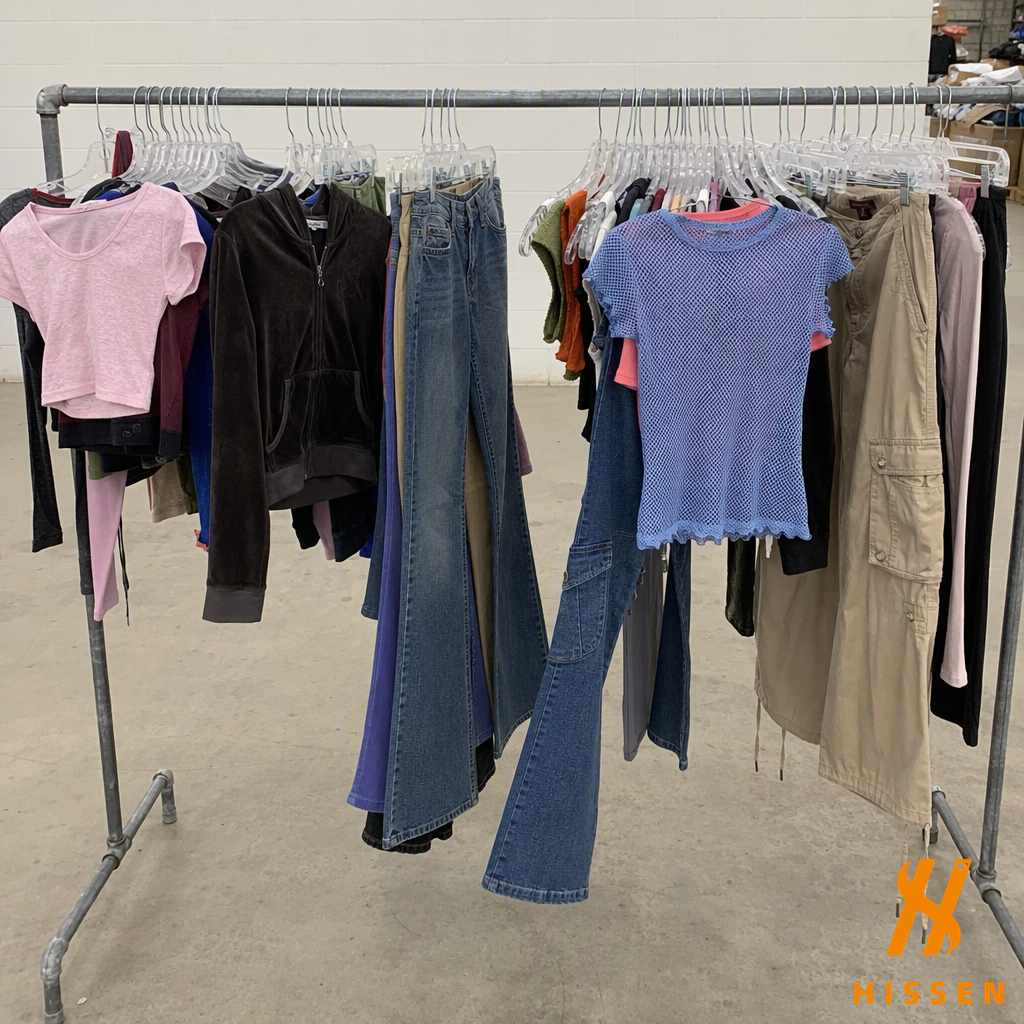
Most Y2K wholesale suppliers use the term loosely to mean clothing produced from roughly 1998 to 2010, with 1999 to 2005 as the core. Anything in that band is defensible. What is not defensible is using the word for a silhouette, which is what most listings do — a 2014 top with a low neckline is not Y2K stock, it is a current garment that resembles one.
The pieces buyers actually ask for cluster tightly: low-rise and bootcut denim, baby tees and cropped tees with printed graphics and logos, velour and terry tracksuits, cargo and parachute trousers, mesh and sheer layering, contrast-panelled sportswear, mini skirts and skirt-over-trouser combinations. Accessories pull strongly too, though bags rarely sit in the same bale as apparel.
The more useful question for a buyer is the opposite one: what from that era has already failed? Twenty-five years is long enough for specific materials to break down, and the failure profile is distinctive enough that it changes what a Y2K bale is worth:
- Anything with elastane in it. Waistbands, ribbed tops, velour, stretch denim. Polyurethane fibres degrade with age and with heat, and the elastic goes brittle rather than stretchy — it snaps instead of recovering. A Y2K bale has a materially higher rate of dead elastic than a 1990s bale, and it is invisible until you pull the waistband.
- Polyurethane-coated and “leather look” garments. The coating delaminates and flakes at folds, shoulders and knees. Once it starts, the garment is finished.
- Heat-cured prints. Plastisol graphics crack from the edges inward, often in a pattern that follows how the garment was folded.
- Bonded rather than stitched construction. Glue lines let go. Seams that were never sewn cannot be repaired economically at resale value.
That is a different risk profile from older eras, where the main issues are fading, thinning and holes. A Y2K lot is a materials-aging problem more than a wear problem, which is why condition checks on this era should be hands-on at the waistband, the underarm and the fold lines rather than visual at arm’s length.
How to Verify an Era Claim on a Garment
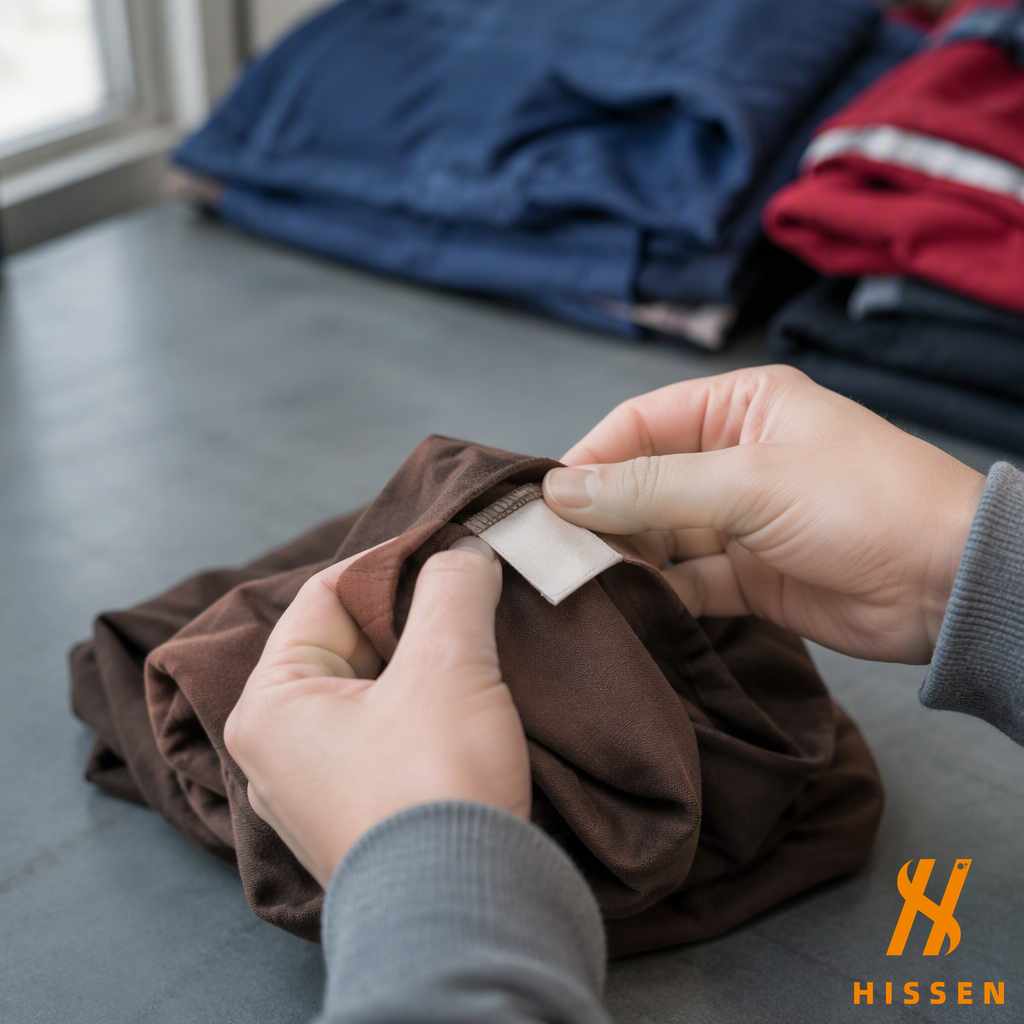
“Y2K” on a stock list is a claim. On a garment it is a set of checkable facts, and the checks are fast once you know what you are looking at — roughly ten seconds per piece on the label, longer only when a piece is borderline.
The label is the primary document
A garment carries two labels that matter: the brand label and the care label. The care label is the more useful of the two because it is regulated, printed with specific information, and much harder to fake convincingly at scale.
In the United States, care labelling has been mandatory since 1971 under the Federal Trade Commission’s Care Labeling Rule; fibre content and country of origin are separately required. In the European Union, fibre composition labelling is mandatory while care symbols are voluntary — so a European garment can legitimately show composition and origin without care symbols, while a US-market garment missing a care label entirely is a warning sign.
Read three things off it. Fibre percentages: a 95% polyester, 5% elastane jersey is a very 2000s signature, as is viscose-elastane, while a 100% cotton heavyweight tee with no elastane reads older. Country of origin: mass apparel volume from Vietnam, Bangladesh and Cambodia is mostly a post-2000 signal, because those export industries scaled in the 2000s, whereas Hong Kong and Macau become progressively rarer as origins after the 1990s. And the label format itself: the multi-language fold-out care label with printed symbols is a later convention than a woven brand tag with a single printed composition line.
For US-market goods, the RN number — the FTC’s Registered Identification Number — ties a garment to a registered business and is a genuine dating aid.
Construction tells
Stitching is the second-fastest check after the label. Single-needle stitching at hems and sleeve seams is broadly a pre-mid-1990s signal in knitwear; by the 2000s, coversewing and double stitching dominate on mass-market tees. A garment sold as Y2K with clearly single-stitched hems is either misdated or is a genuinely early piece — worth knowing which, because the second is worth more.
Also look at the body: tubular knit bodies with no side seams are the older, cheaper construction; the shift toward side-seamed bodies with shaped fits accelerates through the 2000s. And look at internal seams: overlocked everywhere means mass production, which is consistent with the era but tells you nothing about condition. What you are checking for is consistency between the construction and the claimed date.
Fibre and hand-feel
Each era has a material signature: the 2000s are polyester-heavy, with stretch jersey, velour and thin, slightly shiny fabric; the 1990s are heavier, in 100% cotton tees and stonewashed denim. Handle the garment and the decade is usually obvious within a second.
Size tells
Sizing inflated steadily. A size medium from 2003 is measurably smaller than a size medium from 2023, and era grading runs small on top of that. This matters commercially in both directions: a mislabelled size produces returns when your customer resells online, and a buyer who sizes an era lot by tag rather than by measurement will misjudge the whole load. Measure chest and waist on a spread of pieces and build your own conversion, because the tag will not do it for you.
One practical consequence: a Y2K wholesale supplier who offers the era without a stated method of verification is offering a guess. Ask what they check — label, construction, fibre, or nothing — and the answer tells you how much of the era claim is real.
Y2K Wholesale Suppliers Are Three Different Businesses
Almost every quote you receive for “Y2K wholesale” comes from one of three operations, and they are not variations on a theme. They differ in what they can promise, what they cost, and how they fail.
True Y2K from a sorting house
A sorting operation takes collected clothing and grades it: by condition, by category, by season, and — for this segment — by era. What you buy is finite and variable. The stock cannot be re-made, so a lot is a one-off: the same grade bought again next month will be a different distribution. This is the only route to garments that are genuinely twenty years old, and it is priced accordingly, usually per piece or per graded bale rather than on the general per-kilo market.
New production in Y2K style
Factories make Y2K-styled goods from new fabric: vintage-wash tees, low-rise denim, velour sets. This is a legitimate business, and sometimes the correct one. It gives repeatability, a stable price, a defined size curve and a minimum order quantity you can plan around — none of which true vintage supply can offer. What it cannot give you is age. Sold as what it is, it is a product line. Sold as vintage, it is a misrepresentation that surfaces the first time a customer reads a care label or sees the same style restocked for eighteen months.
2010s stock relabelled
The dishonest middle. Garments produced after the window, cut in a Y2K-adjacent silhouette, sold under the word because the word moves stock. The tell is almost always the label: fibre composition and care-label format from a later period, brand names that did not exist in 2004, and cuts that are longer and higher-rise than the era they are claiming. This category is why the era checks in the previous section are worth learning — they cost seconds and they are the only defence you have at the buying stage.
Every quote resolves into one of these three, and the first question in any conversation is which. For how the wider vendor landscape is structured — factories, traders, sorting plants and how each fails differently — see the boutique and thrift store supplier guide and how to build and verify a clothing vendor list. Those pages cover vendor type and verification; this page is about the product claim on top of it.
The Selection Arithmetic: What a Y2K Bale Actually Yields
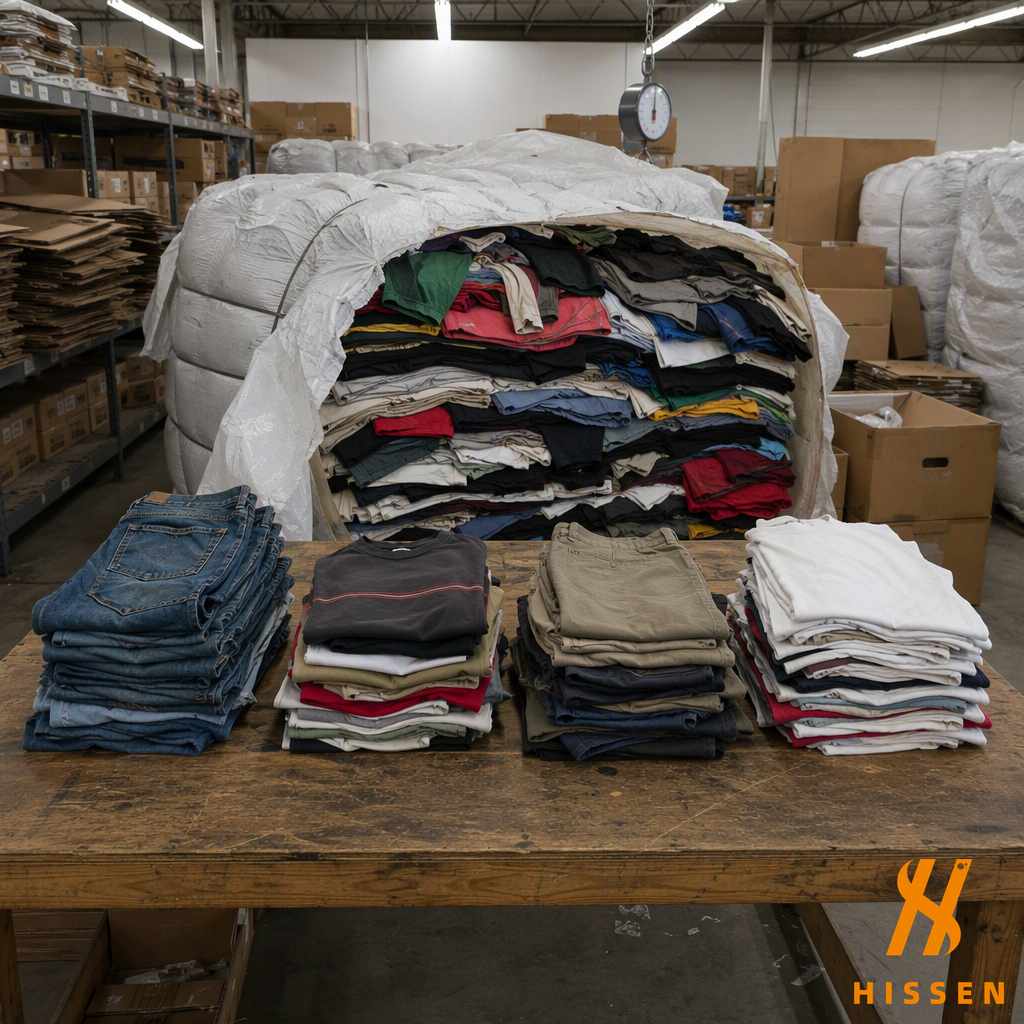
A bale is a distribution, not a product. The weight tells you the cost. The selection rate tells you the value. Almost every bad decision in this trade comes from comparing the first number and assuming the second.
Here is the arithmetic that matters. A 45 kg mixed vintage bale of adult tops, at roughly 0.35 kg per piece, contains about 128 garments. If 40% of those clear your era filter and your condition floor by count, you have about 51 sellable pieces. Your cost per sellable piece is the bale price divided by 51, not by 128.
Now change one assumption. A second supplier’s bale, at the same price per kilo, yields 20% because the era mix is looser and the dead-elastic rate is higher. That is about 26 sellable pieces, so your cost per sellable piece roughly doubles — on an identical invoice, at an identical weight, at an identical per-kilo price.
This is why per-kilo comparisons between Y2K wholesale suppliers are close to meaningless unless three things are stated: the selection rate the supplier works to, the condition floor that rate is measured against, and how the era mix is expressed in the proforma. Without those, you are comparing two prices for two different products that happen to weigh the same.
Bale weights and packing formats vary by origin and by sorter, and the format itself affects how much of the stock survives transport in sellable condition. That is covered in the bales of clothes guide, which is worth reading before you set a per-kilo target.
What Y2K Pricing Is Really Tracking
Ordinary used clothing is priced against a per-kilogram market. Buyers compare bale prices across origins and the market clears at a level determined by what those bales can be resold for in volume, in markets where the customer is buying clothes to wear at a low price.
Vintage and era stock decouples from that market. The customer is not buying cheap clothing; they are buying age and specificity, and they resell at prices set by boutique and online resale demand rather than by the bale market. So Y2K pricing tracks a different curve: what a boutique can sell the piece for, less their margin, divided back through the selection rate.
Two practical implications follow. First, a Y2K price that looks high against the per-kilo market is not automatically a bad price — measure it against sell-through in your own market instead. Second, the supply side has a rising floor. The wave is finite and demand for the era has been growing, so the price of the good pieces does not fall the way ordinary used clothing prices do when a season is poor. Scarcity is doing the pricing, not the bale market.
Which brings up the real risk, and it is timing rather than price. You are exposed to two curves at once: supply, fixed and slowly shrinking, and demand, which follows a fashion cycle with a peak. Buying at the demand peak and selling into the decline is the way this trade loses money, and finite supply does not protect you from it — it just means you are holding an asset nobody wants at a moment when it cannot be replaced either. The margin structure that has to absorb that is set out in the wholesale clothing business guide.
The Decades on Either Side
Before contacting any Y2K wholesale supplier, a buyer who understands the window model can tell in advance which eras are orderable and which are not. The table below is the working picture for 2026: what each decade’s supply looks like in bulk, and what a buyer can realistically ask a supplier for.
| Era | Approximate production years | Status in bulk supply, 2026 | What you can realistically order |
|---|---|---|---|
| Late 1960s and 1970s | 1967–1979 | Wave passed in the 1990s. Remaining stock is held by individual owners and specialist dealers. | Individual pieces only. No bale supply at any price. Buy piece-by-piece and price as rare. |
| 1980s | 1980–1989 | Very thin. Appears as accidental contamination in older bales rather than as a sortable category. | Occasional pieces inside a mixed vintage lot. Cannot be specified, only found. |
| 1990s | 1990–1998 | Mature and thinning. Still baled, but selection rates are falling and heel is heavy on denim and graphic tees. | Graded bales, category sorts, per-piece picking. Expect a lower and less predictable selection rate than Y2K. |
| Y2K | 1998–2010 (core 1999–2005) | Open window. The thickest era stock currently available in sorted form. | Graded bales, era-sorted lots, per-piece picking. Era mix and selection rate can be specified in the proforma. |
| 2010s | 2010–2019 | Too new for the vintage trade. Still mostly in wardrobes, or in the used stream as ordinary grade rather than era stock. | Available only as ordinary used clothing, not as era stock. Any vendor selling it as Y2K is relabelling. |
The awkward conversation follows. A customer asks for 1980s denim in bales because their market wants it. It does not exist at wholesale scale and no supplier will produce it. The honest answers are three: offer the nearest available window and say plainly that it is a substitute; move to the piece-by-piece route and accept that the unit economics change completely; or decline. What does not work is accepting the order and shipping 2010s stock with a 1980s label, because the reputational cost of being caught doing that is permanent in a trade that runs on repeat buyers.
For how older and mixed-era stock is normally described, graded and priced across the whole used range, the used wholesale clothing guide covers the vocabulary your supplier will use.
Writing a Decade Specification Into an Order
An era claim survives contact with a real order only if it is written down as a testable condition. The following belongs in the proforma or the order confirmation, not in an email exchange:
- The era as years, not as a word. “Y2K” is an argument. “Production years 1998–2010, with not less than 70% by count falling in 1999–2005” is a specification. State the band and state the tolerance inside it.
- The category list. Era stock is not one product. Name the categories you are buying, because the era mix inside a bale varies enormously by category — denim and knit tops behave nothing alike.
- The condition floor. State what is acceptable and what is not, and include the era-specific failures: dead elastic, coating delamination, cracked prints. A generic “grade A” does not cover them.
- The selection rate, as a number. What proportion of pieces by count is expected to clear the era filter and the condition floor. This is the clause that turns a vague promise into a measurable delivery.
- How the era mix is expressed. Share by count, share by weight, or share by value — they are three different numbers on the same bale, and a supplier will use whichever flatters the load unless you choose.
- The shortfall remedy. What happens if the lot misses on era mix or on condition. A credit, a replacement in the next order, or a documented deduction — agreed before shipment, not after inspection.
- The price unit. Per kilogram or per piece. They are not interchangeable for era stock, and mixing them across an order is how a per-piece negotiation quietly becomes a per-kilo delivery.
- How inspection is carried out. Which share of the load is opened, by whom, and against what standard. Agree this before the container is packed, because it determines what evidence exists if there is a dispute.
The ordering and inspection mechanics around a mixed-age load — units, minimums, order sequence and claims — are covered in the bulk ordering guide. What that page does not cover, and what this one adds, is the era clause: the part of the specification that only applies because the stock is twenty years old.
Frequently Asked Questions
Where can I buy Y2K clothing wholesale?
From a sorting house that grades by era, and from nowhere else if you want garments that are genuinely twenty years old. Marketplaces and directories mostly list resellers who buy sorted bales and relist them — legitimate, but one step further from the supply, so a higher price and less control over the era mix. Ask any supplier whether they sort the stock themselves, and how they verify an era claim.
Is Y2K the same as vintage?
Y2K is a subset of vintage. Vintage in this trade means clothing old enough to be bought and sold for its age, and the working threshold is around twenty years. Y2K clothing produced from roughly 1998 to 2010 now clears that threshold, which is exactly why it has become a category you can buy by the bale rather than piece by piece.
Are Y2K wholesale suppliers selling real vintage?
Some are, some are selling new production in Y2K style, and some are relabelling 2010s stock. All three are actively quoting under the same words. The way to find out which you are dealing with is to ask about verification method and then check a few labels against the answer — fibre composition, care-label format and stitching will settle it quickly.
How much does Y2K clothing cost wholesale?
There is no single number, because era stock is priced on selection rate rather than weight. Two bales at the same price per kilogram can differ by a factor of two in cost per sellable piece once the era filter and condition floor are applied. Ask for the selection rate and the era mix, then calculate cost per sellable piece before comparing any two quotes.
What is the difference between Y2K and 1990s clothing?
Age, volume and material. The 1990s is a decade further into its supply tail, so selection rates are lower and the surviving stock skews to heavier cotton, denim and graphic tees. Y2K stock is thicker, more polyester and elastane heavy, and far more prone to material failure — dead elastic, flaking coatings and cracked prints — than to simple wear.
Which Y2K items sell best at wholesale?
The ones with the strongest era signal and the least material risk: low-rise and bootcut denim, printed and cropped tees, contrast-panelled sportswear, cargo trousers and mesh layering. Velour and any heavily elastane garment sell well in appearance but carry the highest failure rate, so price them against a lower effective yield rather than at the headline rate.
Can I order a specific decade mix?
For Y2K and 1990s, yes — both can be sorted and the mix stated in the proforma with a tolerance. For 1970s and 1980s, no: that volume no longer exists in the collection stream, and any supplier claiming to ship it in bales is describing something else. Being able to say which of those two answers applies to a given era is most of what era sourcing knowledge consists of.
How do I check if a garment is really from the 2000s?
Read the care label first: fibre percentages, country of origin and label format date it more reliably than anything else. Then check stitching — single-needle hems suggest an earlier garment than the 2000s — and handle the fabric, since the 2000s are polyester-heavy and smooth compared with the heavier cottons of the decade before. Finally measure it: sizing inflated, so a 2000s medium is smaller than a current one.
Sourcing era stock and want the specification to be real before you commit?
Hissen Global is a China-based exporter of graded second-hand clothing and shoes, supplying importers, distributors and sub-wholesalers across Africa, Asia, the Middle East and Latin America. We state the category composition, the grade and the packing format in the proforma, and we will tell you plainly when an era cannot be supplied rather than substitute something that looks close.