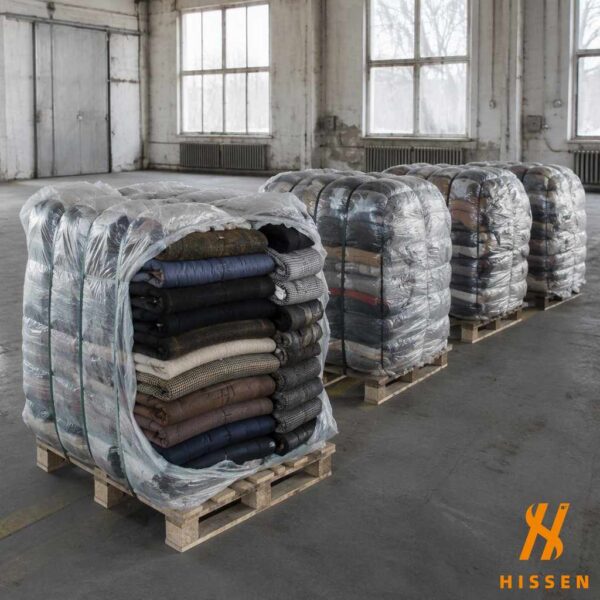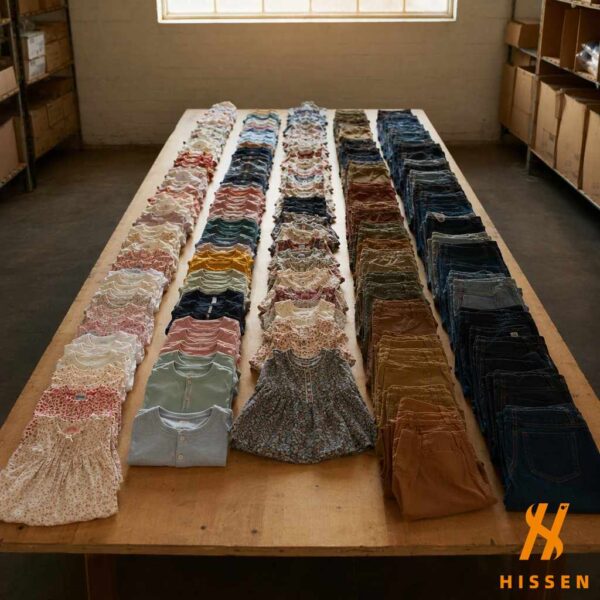
The pairs you most want are the pairs you are least likely to receive. Used denim is the one category in this trade where the sorting house removes its best stock before it bales, because denim has a resale market outside the bale trade that will pay several times the bale price for a single recognisable pair. What reaches a wholesale jeans supplier’s bale is what was not worth pulling.
That single mechanism explains almost everything else about buying denim in bulk: why a bale never contains the vintage pieces you were hoping for, why grade means something different here than in other categories, why denim is simultaneously the most profitable category in the trade and the one with the highest cost per sellable piece, and why the questions that identify a real denim sorter are not the questions that identify a real supplier of anything else.
This page is about the used and second-hand denim trade, sold by weight in bales, and it is written for buyers comparing wholesale jeans suppliers on the exporting side rather than shopping for a single pair. Two other trades answer similar searches and are not this one — denim fabric sold by the metre from a mill, and new-goods denim manufacturing. Both are addressed directly below so you can leave early if that is what you needed.
The Pull: Why a Denim Bale Is a Residue
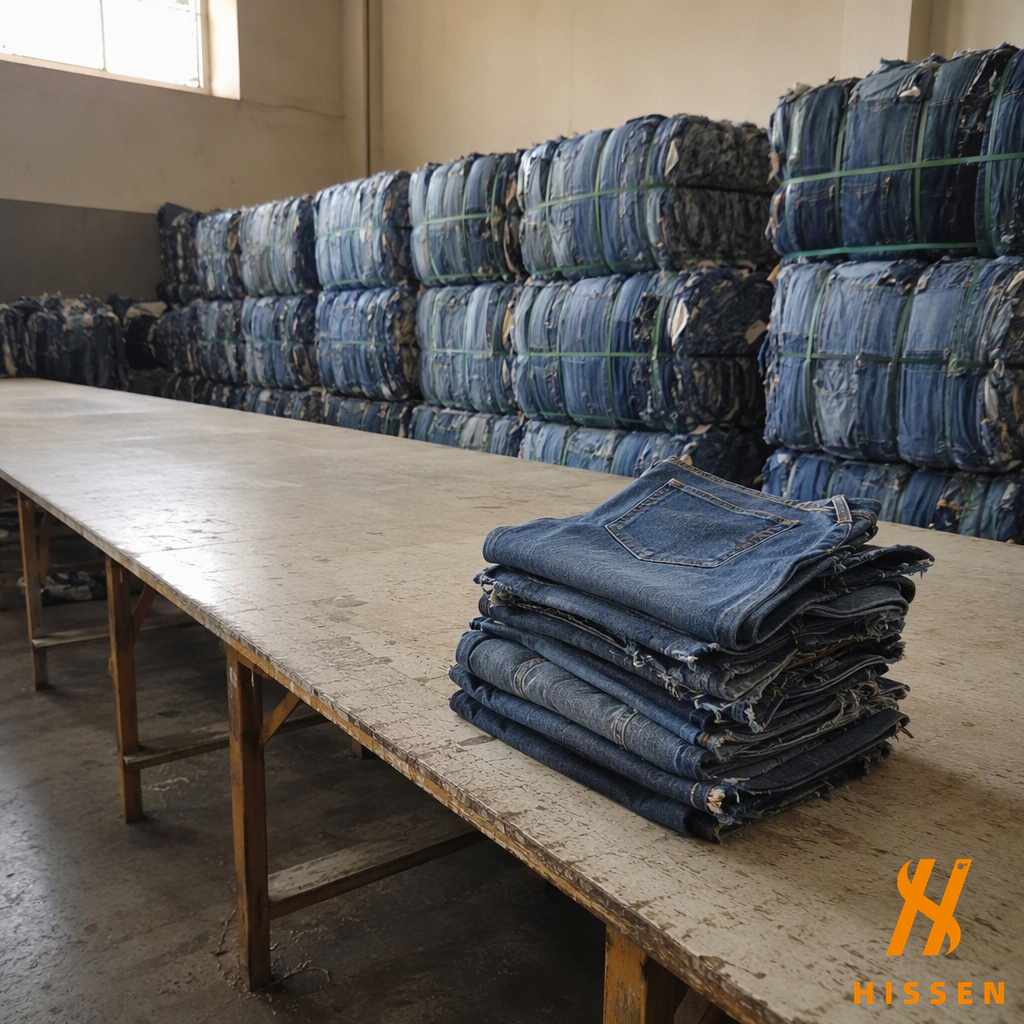
A sorting house produces two outputs from the same input. Most of what arrives is graded and compressed into bales. A small fraction is pulled: removed from the bale line before compression because it will sell for more on its own. In denim, that fraction is larger than in any other category.
The reason is that denim has an external market. A vintage Levi’s 501, a pre-1990s Type III jacket, a pair of narrow-loom selvedge jeans — these sell to vintage wholesalers and specialist dealers at prices that have nothing to do with the per-kilogram bale price. A pair that would contribute roughly $1.40 to the value of a bale can be sold as a pull for $8 to $25 depending on era, condition and label. No sorter who recognises the garment leaves it in the bale.
So the pull rate — the percentage of incoming denim removed before baling — is the single number that separates wholesale jeans suppliers from one another, and it is almost never published. A house pulling 3 percent of its denim is producing a bale that still contains most of what arrived. A house pulling 12 percent is producing a bale from which a meaningful share of the good stock has already gone. Both are honest businesses; they are selling you different products at different prices, and the cheap bale is usually the one with the higher pull rate.
There is a second-order effect that matters more than the rate itself. Whether a garment is pulled depends on whether the sorter recognises it. Generic recognition — the obvious brands, the obvious vintage — happens in every house. Recognition of a late-1970s pair with a specific tab, or a selvedge jean with the right selvedge line, requires a sorter who has been trained on denim. A house that specialises in denim therefore pulls more, and also grades better, because it knows what it is looking at. That is why the best denim bales usually come from houses with a denim line rather than from general sorters, and why the price is higher for a reason that has nothing to do with the grade letter.
Two practical consequences follow. First, if your market can sell a $8 to $15 pair, you should be buying pulls, not bales — the top of the denim market is not accessible through the bale trade at any price. Second, if you are buying bales, ask what the pull rate is and what the house pulls for, and treat a vague answer as a signal that the answer is high.
A note on the country suffixes throughout this cluster. Searches like wholesale denim jackets suppliers in USA, jeans wholesaler in India or wholesale jeans in Lagos are buyers looking for a domestic wholesaler in their own country, which is a different question from this page. An exporter ships into those markets; it cannot be a domestic wholesaler inside them, and a supplier claiming to be both is usually a trading company with no stock.
A note if you were looking for denim shorts to wear, not to resell
A large share of the searches behind this topic are retail shoppers — where to buy denim shorts near me, where to buy cute denim shorts, where to get cheap jean shorts. This page cannot help you, and it would not be honest to pretend otherwise. It is written for buyers purchasing by the bale, typically half a tonne upward. The connection between the two markets is real but one-directional: the garments sold in retail shops are, at the other end of the chain, exactly the stock described here, sorted and graded in bulk. If you are shopping for yourself, a retailer is the right place to be.
Denim Fabric Is Sold by the Metre, Not by the Kilo
The single largest source of confusion in this category is that denim fabric suppliers and denim garment suppliers share a name and nothing else. Fabric is sold by the linear metre or the roll, from a mill, to a factory. Garments are sold by the kilogram, in bales, to a reseller. They are not adjacent steps you can move between; they are different industries that both contain the word denim.
The fabric trade runs on a different vocabulary and a different unit system: weight in ounces per square yard, width in inches, selvedge or wide-loom, shrinkage after wash, and indigo dye lots that do not repeat. Minimums are quoted in metres or rolls and the buyer is usually a garment manufacturer who will cut the cloth rather than sell it on. Mills that matter sit in Turkey, Japan, Italy, China and increasingly India and Pakistan.
This site does not sell denim fabric, and no used-clothing exporter does — wholesale jeans suppliers of the kind described here deal in garments only. If fabric is your requirement, the fastest way to sort the mills from the middlemen is to state your ounce band in the first message: roughly 10 to 12 ounces for shirting and light jackets, 12 to 14 for standard jeans, 14 to 16 for heavy and raw denim. A mill will answer with a specification. A trader will answer with a price, which tells you they are reselling and do not control the loom.
What follows is about garments only: sorted, graded second-hand denim, bought by weight.
Denim Is the Heaviest Common Garment, So a Bale Holds Half the Pieces
Every other category’s arithmetic breaks when you apply it to denim, because denim is dense. A pair of men’s jeans weighs roughly twice what the average garment in a mixed bale weighs, and a denim jacket weighs more still. The result is that a denim bale contains far fewer sellable units than any other bale of the same weight. That is the first thing to internalise before comparing wholesale jeans suppliers, because every quote you receive will be per kilogram while every decision you make is per pair.
| Denim type | Average weight | Units in 45 kg | Sellable rate (modelled) | Cost per sellable unit |
|---|---|---|---|---|
| Men’s jeans | 0.70 kg | 64 | 70% | $2.00 |
| Ladies’ jeans | 0.48 kg | 94 | 65% | $1.33 |
| Denim jackets | 0.85 kg | 53 | 72% | $2.61 |
| Denim shorts | 0.30 kg | 150 | 68% | $0.75 |
| Denim skirts | 0.40 kg | 112 | 70% | $1.04 |
| Mixed adult, for comparison | 0.35 kg | 128 | 66% | $1.02 |
These figures are a model, not a quotation. They use illustrative Grade B prices of $2.00 per kg for men’s jeans, $1.80 for ladies’ jeans and skirts, $2.20 for jackets and $1.70 for shorts, against typical used-garment weights and modelled sellable rates. Substitute your own price and weigh-in; the relationships hold even when the numbers move.
The comparison that matters is the second-to-last line. Forty-five kilograms of mixed adult clothing is around 128 pieces, or roughly 84 sellable ones. Forty-five kilograms of men’s jeans is 64 pairs, or roughly 45 sellable ones. Same money, roughly half the units. A buyer who has learned pieces-per-kilo from another category and applies it to denim will order half as much as they need and discover it only when the retail shelves are empty in week three.
The compensation is on the other side of the ledger. Used denim resells at $3 to $8 a pair in most markets, and branded pairs at $5 to $15, which is far above the typical resale price of a mixed-bale garment. The cost per sellable pair is the highest in the trade and so is the revenue per unit, which is exactly why denim sits at the top of most profitability rankings. It is a high-value, low-count category, and the whole discipline of buying it is about protecting the count.
What Grade Means in Denim: The Failure Map
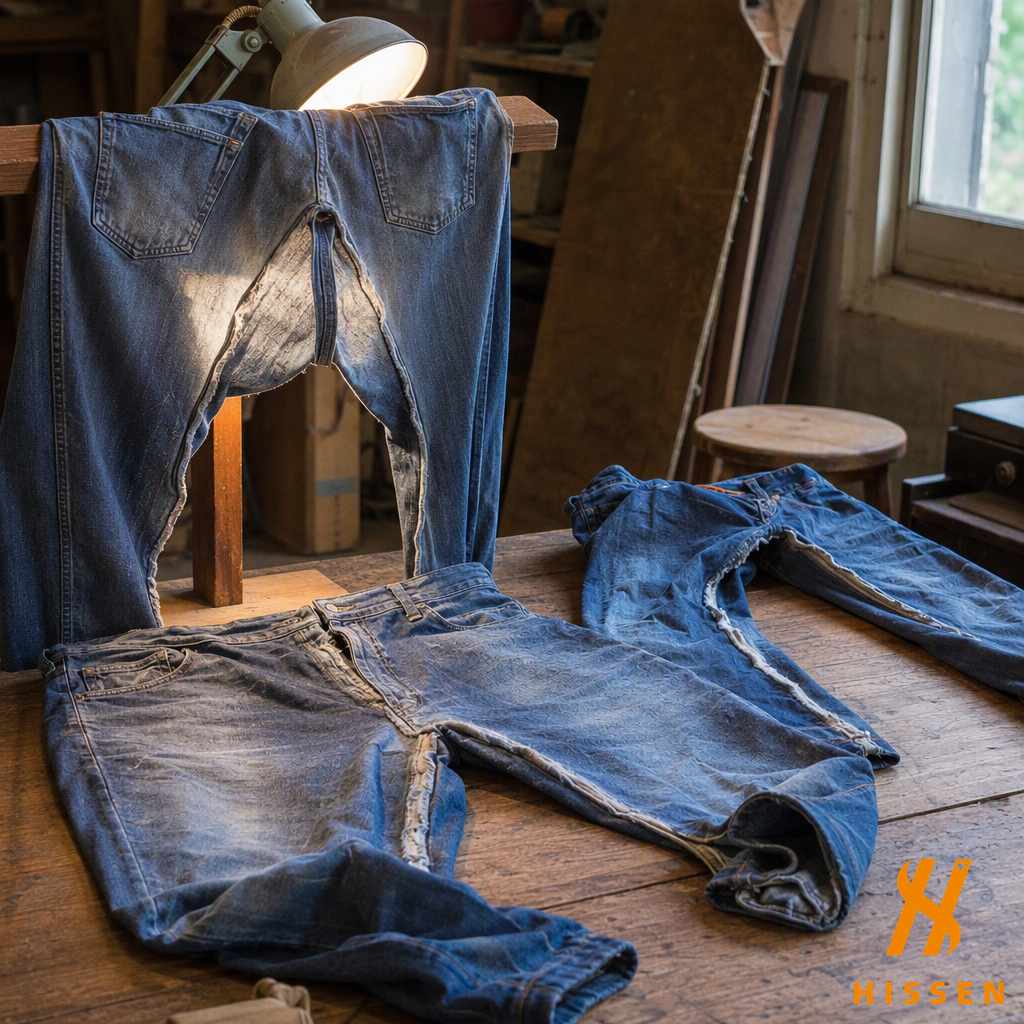
Denim does not fail where other garments fail. It is one of the most durable fabrics in common use, so it rarely wears through from ordinary use — but it fails in a small number of very predictable places, and those places are what a denim grade is actually measuring.
The crotch and inner thigh is the first. Friction between the legs, concentrated at a seam, produces thinning and then a blowout, and it is the single most common reason a used pair is unsellable. Check it on every pair in a pull, holding the fabric up to light: thinning shows before a hole appears, and a pair that is one wash from a blowout is a reject even though it photographs well.
The knees, hems and back pockets are the next three. Hem drag frays the bottom edge; carried wallets and phones wear through the pocket bag; kneeling thins the knee. None of these is fatal on its own, and all of them are what a buyer sees first.
Beyond wear, denim has two structural defects that no other category has:
- Cut-offs. Jeans that were converted to shorts before donation. The legs are gone and the hem is raw. A sorter may or may not have moved them into the shorts category, and a bale described as jeans will often contain a percentage of them. They are not defective as garments; they are simply not jeans, and if your market sells jeans you cannot use them.
- Altered waists and taken-in seams. Jeans that were tailored. A waistband taken in by two inches, or a leg narrowed, changes the size on the label. The pair reads as one size and fits as another.
Two further points decide the grade in practice. The first is repairs. A patched knee or a darned crotch is a defect in a market where customers expect unmarked clothing and a positive feature in a market that values visible mending, so a house grading for one market will systematically misgrade for the other. The second is fibre. Jeans made with elastane, which is most of the women’s market and a growing share of men’s since the early 2000s, fail differently from 100 percent cotton: the stretch recovers badly, the garment bags at the knee and seat, and old elastane perishes outright. A ladies’ denim bale from a recent donation stream is a stretch-denim bale whether or not it says so.
The pull that tests all of this takes ten pairs and about three minutes, and it is the one check that separates real wholesale jeans suppliers from resellers. Hold each pair up to the light at the crotch. Look at the hem. Check the zip and the button. Stretch the waistband. If three of ten fail the crotch check, the lot is not the grade it was sold as, and no amount of negotiation on price fixes a bale whose reject rate has already been set at the sorting table.
The Distressed Paradox: Grade Is Relative to the Market
The same pair of jeans can be a premium garment in one market and dead stock in another, and this is more true of denim than of any other category in the trade.
In markets where worn denim signals authenticity — vintage shops, western-wear resellers, and the resale platforms that serve them — fade, whiskering, repaired knees and visible patches are the product. A pair with honest wear sells above a pair that looks new, because looking new is what a reproduction looks like and buyers at that end are paying for evidence of age. In most African and Asian resale markets the logic inverts: a customer is buying durable clothing at a low price, and a faded pair reads as a worn-out pair. The same garment that is grade A in one destination is grade C in the other.
This is why a grade letter on a denim bale means nothing until you know which market the grader had in mind. Ask wholesale jeans suppliers directly whether they grade for a European vintage buyer or for a market stall, and expect a different answer from different houses — both honest, neither interchangeable. If you buy a bale graded for one and sell into the other, the grade was accurate and your order was still wrong.
There is one shortcut worth knowing. Genuine wear and factory distress look different under a hand. Factory-distressed denim has clean, deliberate cuts, even abrasion and finished edges, because the damage was designed to survive repeated washing. Genuine wear has frayed edges, uneven colour loss concentrated at the points that actually rub, and strain marks at the seams. A lot described as distressed may be a lot described from a fashion market’s point of view; a lot described as worn may be genuinely worn out. Ten seconds with a hem tells you which.
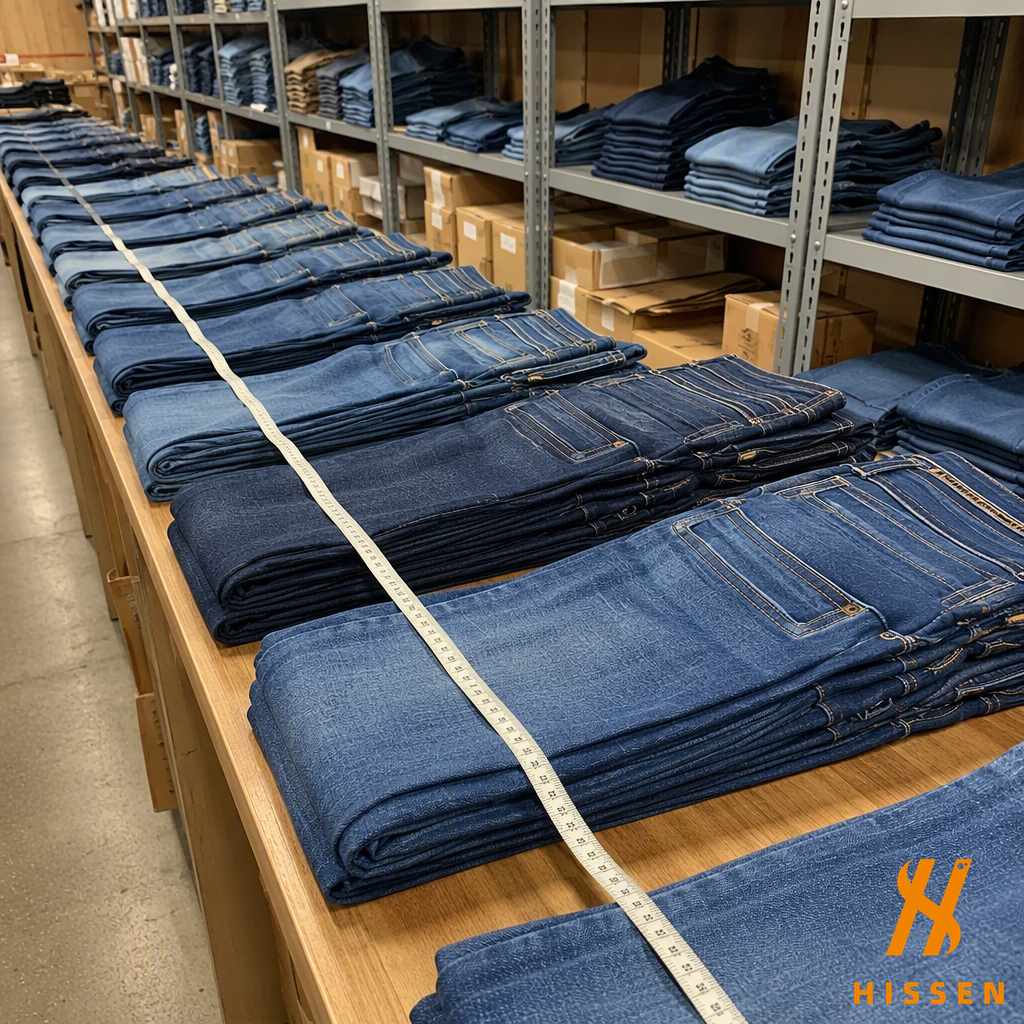
The Waist Run Carries the Source Country
Denim is sized by waist and length, not by small, medium and large, and that changes what a bale is. A bale of jeans is a distribution of numbered sizes, and the distribution was set by the bodies of the people who donated, not by the bodies of the people who will buy.
In practice, a men’s bale sorted from Northern European or North American sourcing peaks around W32 to W34 and carries a meaningful tail to W38 and beyond. A bale sorted from East Asian sourcing peaks several sizes smaller. Buy a bale from a source population larger than your market and a portion of every bale is stock you cannot move; buy from a smaller source population and you run out of the sizes that sell first. The same 45 kilograms can be 80 percent in your sellable waist range or 40 percent, and nothing on the invoice distinguishes the two.
Length compounds it. A sourcing stream from a taller population produces L32 and L34 lengths that are unsellable in a shorter market without hemming, and hemming converts a $3 pair into a $2 pair after labour. If you have ever wondered why two denim bales at the same price and the same grade perform completely differently, the waist and length distribution are usually the answer.
Ladies’ denim is harder still, because the industry abandoned numbered waist sizing for vanity sizing. A size 10 made in 2005 and a size 10 made in 2020 are different garments, sometimes by two inches of waist. Labels in a ladies’ bale are therefore unreliable as a size statement and reliable only as a rough ordering. Measure ten pairs from the pull rather than reading the tickets, and specify ladies’ denim by measured waist if your supplier will do it.
What You Can Specify in a Denim Order
Used supply is not made to order, so every specification you give wholesale jeans suppliers is really a sorting instruction, and every sorting instruction has a cost. Denim has an unusually generous list of things that can genuinely be specified, because so much of what matters about denim is visible.
Reasonable, in roughly ascending order of cost:
- Category: jeans, jackets, shorts, skirts, or a defined mix. Structural and cheap to control.
- Gender split: men’s, ladies’, youth, or a percentage. Ask for 70 percent men’s rather than 100 percent; the rest exists whether you want it or not.
- Waist and length range: the highest-value specification in the category, and the one that most changes what you can sell. Narrow ranges cost more and are worth it.
- Wash: light, mid or dark. This is the specification denim uniquely allows, because wash is a visual property and a sorter can separate it at the table without opening the garment. If your market has a strong preference, use it.
- Damage tolerance: pristine only, light wear, or distressed accepted. This is the specification that decides whether the bale suits a vintage buyer or a market stall.
- Exclusions: no cut-offs, no altered waists, no elastic-waist or jegging styles, no children’s sizes. An exclusion list is usually free or nearly free and removes whole classes of stock you cannot sell. It is the cheapest quality improvement available in this category.
Not available at any price: brand, specific fits beyond a broad cut description, exact sizes within a range, era, or the presence of particular labels. Asking for these does not produce a better bale. It produces a supplier who says yes and ships what they have, which is worse than a supplier who says no.
Five Questions That Separate a Denim Sorter From a Trader
General supplier vetting — licences, payment terms, whether the vendor is a factory or a trading company — is the same for denim as for any category and is covered elsewhere on this site. What is specific to denim is that the answers to five questions will place a supplier precisely, because only a house that actually sorts denim can answer them.
What is your pull rate on denim, and what do you pull for? The answer tells you how much of the good stock has already left and whether the house understands denim as a category or treats it as one line among many. A sorter will name what they pull — vintage Levi’s, selvedge, specific brands — and give a rate. A trader will estimate.
What was the waist run of your last men’s bale, in counts? This is the denim equivalent of asking a bookkeeper for the ledger. A house that sorts by waist has the distribution. A house that does not will offer a range instead of a distribution, which is a different and much less useful answer.
How many pairs per kilo did your last denim lot run? Men’s jeans average around 1.4 pairs per kilogram. Anyone who weighs their stock knows their own figure. An answer of three pairs per kilo is not a denim answer at all.
Are cut-offs and altered waists removed before baling? This question reveals whether the house applies a denim-specific sorting standard or simply compresses everything that is blue. A house that removes them is charging for the labour and is worth the charge.
Where do your pulls go? If the answer names a vintage wholesaler, a specific export market or a named buyer, the pull operation is real and you are buying its residue knowingly. If the answer is vague, either the pull is small or the house is not the sorter it claims to be — and in that case you may be buying unsorted stock at a sorted price.
Finish with the arithmetic. Forty-five kilograms of men’s jeans at 0.70 kilograms a pair is 64 pairs. If a supplier quotes you 110 pairs for a 45 kilogram men’s bale, then either the weight is not 45 kilograms, or the bale is not men’s jeans, or a large share of it is shorts and cut-offs. One division catches all three, and it costs nothing to perform before the container is booked rather than after.
The Vintage End: Selvedge, Japan and Re-labelling
If what you actually want is vintage denim, understand that it is not purchasable through the bale trade at any price. It is a pulls market: individual pairs, individually graded, sold by dealers and at vintage wholesale, priced per piece. Volume buyers who want to enter it usually buy pulls by the hundred rather than bales by the tonne.
The reason is that genuinely vintage denim is identifiable and therefore extractable. Pre-1990s Levi’s 501s with the era markers collectors use, Type I, II and III jackets, and narrow-loom selvedge denim all have a recognised market. Because the market is recognised, sorters recognise the garments, and because sorters recognise them, they never reach a bale.
That market also has the trade’s worst counterfeiting problem, which is worth knowing even if you never buy into it. Modern pairs are presented as vintage; a red selvedge line is added to wide-loom cloth; replaced tabs and hardware pass a photograph; and Japanese reproduction denim — Evisu, Sugar Cane, Full Count, Studio D’Artisan and others — is made deliberately to resemble mid-century American denim and is sometimes resold as though it were. Fast dating comes down to the tab, the hardware, the stitching and the care label, in that order.
One honest note on Japan, since it appears in this cluster as japanese denim supplier and where to buy japanese denim fabric. Japan is a genuine centre of both vintage denim and high-quality reproduction, concentrated around Okayama and Kojima, and its output is excellent. It is also a specialist dealer and mill market that does not pass through Chinese used-clothing export in any volume. If you are looking for Japanese vintage denim in bulk from a general used-clothing exporter, that supply does not exist in the form you are imagining, and a supplier who offers it is almost certainly offering reproduction or relabelled stock.
Where Denim Sits in Your Container
Denim has the highest value per tonne and the lowest unit count per tonne of any common category in this trade. Both facts point the same way for an importer planning a load.
Because the units are few and the value is high, a container of denim carries far fewer sellable garments than a container of mixed clothing at the same freight cost. That is efficient if you can sell them: fewer units at higher prices means less handling and better margin per square metre of shop. It is dangerous if you cannot, because a denim container represents more working capital locked into fewer, more expensive items, and it clears more slowly in a market that buys on price rather than on category. The practical rule is that denim should rarely be your first container unless you already have more than one outlet to move it through.
Denim also combines badly with light categories in a mixed load. Bales are compressed to a standard weight, so the constraint is the total tonnage rather than the volume, and adding dense denim to a load of light garments does not let you carry more of either. What it does is concentrate your risk into one category you may or may not be able to sell through.
For the surrounding context, the profitability ranking that places denim first among all categories is in the used clothing categories ranked guide, which is the closest thing this site has to a denim overview. Grade and category vocabulary across the whole trade is defined in used wholesale clothing. The pieces-per-kilo reference covers the general weight arithmetic that this page has applied to denim specifically.
On the mechanics, the bale format itself, the ordering sequence and container arithmetic that applies unchanged to denim, and the four vendor types and twenty-minute qualification test that this page deliberately does not repeat. For the vintage side of the vocabulary, second hand and vintage clothing sets out how the trade defines vintage at all. And for the commercial arithmetic downstream of the bale — margin, cash cycle, and what a category needs to carry — the wholesale clothing business guide covers the ground this page leaves alone.
Frequently Asked Questions
Are wholesale jeans suppliers the same as denim fabric suppliers?
No, and the two are not interchangeable at any point. Denim fabric is sold by the linear metre or the roll from a mill to a garment factory, specified in ounces per square yard and quoted in metres. Denim garments are sold by the kilogram in bales to a reseller. A used-clothing exporter sells the second and cannot supply the first.
Why is there no vintage Levi’s in a denim bale?
Because it is pulled before baling. A recognisable vintage pair sells to a vintage dealer for several times what it would contribute to a bale, so no sorter leaves it in. The bale is the residue after that extraction, and the pull rate — what percentage of incoming denim is removed — is the number that tells you how much of the good stock has already gone.
How many pairs of jeans are in a 45 kg bale?
Around 64 pairs of men’s jeans at roughly 0.70 kg each, or around 94 pairs of ladies’ jeans at roughly 0.48 kg. Denim jackets run to about 53 units and denim shorts to about 150. Denim is the heaviest common garment, so a denim bale holds roughly half the units of a mixed adult bale of the same weight.
What is a normal price per pair for used jeans?
It depends on the grade, the category and the pull rate. As an illustration only, a 45 kg men’s Grade B bale at $2.00 per kg is $90, or about $1.40 per pair before rejections, and about $2.00 per sellable pair once a 70 percent sellable rate is applied. Used denim resells at $3 to $8 a pair in most markets and $5 to $15 for branded pairs, which is why the category ranks so highly despite the high cost per unit.
Why is used denim more expensive per pair than other categories?
Because there are fewer pairs per kilogram. A mixed adult bale at 0.35 kg per piece yields around 128 units in 45 kg; men’s jeans at 0.70 kg yield around 64. The cost per sellable unit is therefore roughly double, and the resale price per unit is also higher, so denim is a high-value, low-count category rather than a cheap one.
What waist sizes are in a men’s denim bale?
Whatever the donating population wore. A bale sorted from Northern European or North American sourcing typically peaks around W32 to W34 with a tail to W38; a bale from East Asian sourcing peaks several sizes smaller. Ask for the waist run of the last bale in counts rather than a range, and match it to the body sizes of your own market.
Are cut-off shorts included in jeans bales?
Often, unless they are explicitly excluded. Jeans converted to shorts before donation still read as denim at the sorting table, and a house without a denim-specific standard will compress them into the jeans bale. Adding “no cut-offs, no altered waists” to your order is usually free or nearly free and removes a whole class of stock you cannot sell as jeans.
How do I check the grade of a denim bale before I pay?
Ask for the piece count and weight of one specific bale and divide: 45 kg of men’s jeans should be around 64 pairs. Then take a ten-pair pull and hold each pair to the light at the crotch, which is where used denim fails first. If three of ten show thinning or a blowout, the lot is not the grade it was sold as. Check the hem for drag and the waistband for alterations at the same time.